Thursday, March 23, 2006

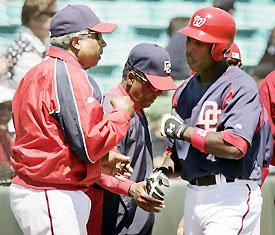
Alfonso Soriano - The Next Curt Flood?

Is it possible that Alfonso Soriano’s recent struggles with the Washington Nationals allow him to be placed in the same company as Curt Flood?

Um, no. And, sadly in the end, he wasn’t even close. But there was an opportunity in the Soriano case that was missed. An opportunity to make a statement about a cold business. About fairness. It was an opportunity to do the right thing. And, unfortunately, Soriano chose to pass it up.

Let me refresh your memory about Curt Flood. After the 1969 season, when he was still just 31-years old and coming off a Gold-Glove winning, .285-hitting season as the Cardinals center fielder, Flood and three other players were unceremoniously traded to the Phillies in exchange for Dick Allen and two others. Flood refused to report to the Phillies, citing the racism displayed by their fans, the poor performance of the club, and the awful condition of their stadium as reasons why he didn’t want to play in Philadelphia. And, in his view, not wanting to play there meant that he shouldn’t be forced to play there. This was America, after all, where a man could choose to work wherever he saw fit.

Unfortunately for him, Commissioner Bowie Kuhn didn’t see things the same way. Citing the ages-old reserve clause that bound a player to one team for his entire career unless released (or traded, which transferred that right to his new team), Kuhn refused to approve a request by Flood that he be declared a free agent. Flood sued, claiming that the reserve clause had the effect of treating him and other players like property rather than people, an inherently un-American principle.

The case reached the Supreme Court, which upheld lower court rulings in favor of Major League Baseball. The impact on Flood’s career was extreme. Having sat out the entire 1970 season, he signed with the Washington Senators for the 1971 season, but faced with widespread criticism for his actions, he performed poorly, and retired after playing only thirteen more games. He was just 33-years old, and for all intents and purposes, had sacrificed five or six years at the end of his career, at six-figure salaries each year, to make the point that baseball players should have the same rights as other workers in this country. Thankfully, in Flood’s case, his sacrifice wasn’t fruitless, because the reserve clause he fought against was finally struck down just five years later.

All of which brings us to Alfonso Soriano. In a modern repeat of Flood’s situation, Soriano was traded against his will to a team he had no interest in, that plays in a league in which he has never played, in a stadium that doesn’t suit his skills, and with the expectation that he would switch to a position, left field, that would likely decrease his free agent value a year later.

From his perspective, it was a crappy deal, and he rightly was upset about it. Now, keep in mind that this isn’t a troublemaker. Soriano is a kid from the Dominican Republic who went to Japan for a couple of years as a teenager to establish himself as a professional ballplayer, and took it upon himself to learn to speak Japanese in order to fit in. He eagerly moved from his naturally position, shortstop, to left field when the Yankees acquired him. He did it without complaint and actually played the position well in Spring Training of 2001. Then, when the Yankees finally decided that Chuck Knoblauch’s throwing problems weren’t going away, Soriano agreed to change positions again, to second base. He flourished there, becoming one of the most dangerous power hitters in the history of the position and nearly winning the 2001 World Series by hitting an 8th-inning homer in Game Seven that gave the Yankees the lead. Only Mariano Rivera’s famous blown save kept Soriano from being the hero.

After doing all of this for New York, they dealt him to the Rangers before the 2004 season in exchange for Alex Rodriguez, essentially because the Yankees had a unique opportunity to acquire a great player and because they considered Soriano expendable after he had a terrible 2003 post-season.

So here we have a guy who has done nothing but work hard and travel far and wide to become a big league ballplayer, who has selflessly changed positions not once but twice for the good of his team, only to have that team trade him away when it suited their interests, and now he was faced with being dealt again and asked to change positions again, because the team that acquired him already had a second baseman.

How much more “good of the team” behavior should really be expected of this guy? He had already proven, time and again, that he’s a team player. And what did that get him? It got him the reputation of being a guy who could be moved around to suit the team’s needs, leading the Nationals to make the deal without ever asking him in advance if he would be willing to move to left field. Of course he would move, they must have thought. He’s done it before, twice.

Well, this time was different. Soriano had all the leverage in this case, since he was slated to make a ton of money and the Nationals desperately need him in their lineup, plus the fact that he’s going to be a free agent after this season, meaning the Nationals could lose him and get nothing in return if they make him unhappy.

Plus, he had every right to make a stink about how he was treated. The Nationals and Rangers, like the Cardinals and Phillies years ago with Flood, treated Soriano like property. They didn’t care about where he wanted to play, or which team he wanted to play for, or how much money a move to left field would cost him. They acted like all big businesses do these days, they treated the employee like an expendable asset instead of like a human being. This was a case of Corporate America at its finest.

“You’ve got Little League practice for one of your kids? Tough, I need this PowerPoint pitch done tonight.”

“You just bought a house here in town? Oh well, I need you to move to Detroit. You can commute back home on the weekends if you don’t want your kids yanked out of school mid-year.”

“I know you’re eighteen months away from retirement, but the company is restructuring after the recent merger, and your former job is no longer necessary, so we’re letting you go.”

Workers in Corporate America aren’t people anymore. They’re not even “personnel”. They’re “headcount”, all subject to some quaint euphemism for being forced out of a job they perform perfectly well. Reduction in Force. Laid Off. Downsized. Subject to Synergy. That last one is my favorite.

And yet, in Soriano’s situation, he has been widely criticized for standing up like a man and saying “Enough.” He didn’t take one for the team, and that makes him the bad guy.

Well, my question is this; when is the team going to take one for Alfonso Soriano? Sure, they pay Soriano a ton of money, and that makes his case even less sympathetic, but with that kind of money at stake, isn't is just good business for the Nats to make sure Soriano would be happy with the move? When did the Nationals become exempt from caring about their players’ well-being? Haven’t they just revealed themselves as an organization that has no interest in doing what’s right for their players? How hard do you think it’s going to be to attract quality people to play for them now?

I won’t criticize Soriano for the stand he started to take. I think it was noble, or at least qualifies for that description under today's standards. What I criticize him for is giving up. He caved in yesterday when he trotted out to left field, despite having all of the leverage on his side. Soriano passed up the opportunity to be this generation’s Curt Flood, a man who would sacrifice his own interests to make the point that ballplayers, and other workers in America, aren’t just inanimate assets for companies to spend as they see fit. They’re people, and you shouldn’t treat people, especially good people like Alfonso Soriano, the way the Nationals treated him. It would have been a great statement for Soriano to make.

Unfortunately, I guess we’ll have wait for someone else to make it.

Sunday, March 05, 2006

A Major Mistake

Pretend for a moment that next season, a new baseball league is formed.

This new league will exist for exactly one season, during which many of its teams will cease to exist or re-locate in mid-season. Replacement teams in replacement cities will be hastily formed, some playing as few as nine games, but those games will be included in the standings nonetheless.

Administration of the league will be shoddy, at best. No statistics will be kept for RBI, or strikeouts, or double plays, or stolen bases. Of the twenty-two men who will come to bat for the league champion, it will be unclear from league records which side of the plate eight of them bat from, including the starting catcher and left fielder. Three men from the eleven-man pitching staff also won’t be identifiable as lefty or righty.

The players will be comprised of journeymen, some of them with brief, undistinguished major league experience, but over two-thirds with no big league experience of any kind. For instance, the starting shortstop on the league champion will be a 22-year old whose sole year of professional baseball experience will be this one season in this new league.

For the sake of argument, let’s say that the level of talent is such that almost two-thirds of the players will never be given another chance at the big leagues. The league’s MVP, upon returning to the National League, will manage to hold a job as a regular for just three more seasons, and won’t post an OPS higher than the league average after age 29. Someone like Ryan Freel, currently the primary bench player for the Cincinnati Reds, can be one of the league’s stars. He will be the league’s best third baseman, starting at that spot for the league champion, and he will finish in the top-five in the league in batting average, on-base percentage, slugging percentage, OPS, doubles, home runs, and walks. His batting average will be nearly 50 points higher and his OPS 140-points higher than his career marks in the National League, in large part because the new league’s teams average nearly six runs per game. After the league disbands, Freel will return to the National League, but will last parts of just two more seasons, hit .186, and retire.

Now imagine that, forever more, baseball historians would consider Freel’s season in this rogue league to be the functional equivalent of Albert Pujols’ rookie season.

All together now…“Huh?”

Before you call me crazy, let me assure you that I’m not making any of this up. This exact scenario has already happened.Way back in the 19th Century, back before the major leagues were as organized as they are today, there was a one-year blip just like the one described above. Its was called the Union Association, and, incredibly, it is considered to be a “major league” to this day.

In perhaps the first instance of players feeling crapped on by ownership, the Union Association formed in late 1883 with the intent of raiding disgruntled players from the National League and American Association, the two recognized “major” leagues, both of which exercised reserve clauses in their player contracts. Such a clause tied players to a team until that team didn’t want them anymore, a situation that would be so for almost 100 more years, and it never sat well with players. Many of them hated it enough to give the new league a look.

The problem for the Union Association was that few of those established players took them up on their offer. Of the 238 different positional players who played at least one game in the Union Association, over 68% had never played major league baseball. Of the group that did have big league experience, few had played much. They averaged just 105 big-league games upon joining the Union Association. When the players with no previous experience were counted, all of the hitters in the league averaged just 33 games of major league experience.

The talent level was such that one of the league’s few players with real major league experience, Fred Dunlap of the St. Louis Maroons, had little problem establishing himself as the league’s best player. With four years as the regular second baseman for the National League’s Cleveland Blues under his belt, he easily led his new league in batting average, on-base percentage, slugging percentage, OPS, runs, hits, total bases, doubles, home runs, adjusted OPS, runs created, extra-base hits, and time on base. A solid player in Cleveland, Dunlap suddenly was Babe Ruth in the Union Association. His .412 batting average was 86 points higher than his previous career best. His OPS+ mark of 250 was higher than all but one of the seasons in Ruth’s career. Upon returning to the National League the next year, Dunlap’s OPS+ was halved, to 122, a mark he never matched again.

And that was the league’s best player. Lesser lights were much less distinguished. Orator Shaffer finished second in most of the league’s hitting categories, despite being a 32-year old journeyman outfielder who had already played for eight big league teams. His OPS+ the previous year was 103, barely above league average and just fifth-best on his 1883 Buffalo Bisons team, yet he managed to bat .360 in the Union Association, 85 points higher than his career mark, and his OPS+ of 196 was a mark never glimpsed by the likes of Hank Aaron, Willie Mays or Joe DiMaggio. Upon returning to the big leagues, Shaffer batted .249 and had an OPS+ of 100, both league-average marks.

The career record of Harry Moore, the starting left fielder for the Washington Nationals, reads pretty quickly:

Debut – April 17,1884
Final Game – October 19, 1884
Bats – Unknown
Throws – Unknown
Birth – Unknown
Death – Unknown
Major league games before joining the Union Association – zero.
Major league games after leaving the Union Association – zero.

And that, ladies and gentlemen, was the Union Association’s third-best hitter, with a batting average of .336.

It should be abundantly clear that the talent level in the Union Association was nowhere near that of the major leagues. It was essentially Triple A. And yet, there are the stats from the Union Association in “Total Baseball”, next to the numbers players posted in the National League, American League, and every other league that could reasonably be called “major”.

Some may not consider that to be a big deal. I do, and not because the numbers in question affect any records or corrupt any career marks. They don’t. But as long as the UA is considered a major league, historians and statisticians are going to have to account for it. They have to measure its players and compare them to players from real major leagues. The results are often ridiculous.

For instance, remember the Ryan Freel example? The player in question was Jack Gleason of the UA’s St. Louis Maroons. Prior to jumping leagues, Gleason was a mid-level starter in the American Association, at the time a major league. After a one-game debut in the National League at age 22, Gleason failed to make a big league roster again for five years. He resurfaced as the third baseman for the American Association’s St. Louis Brown Stockings in 1882, batting .254 and posting an OPS that was about 5% better than the league average. After a slow start the next season, he was dealt to the Louisville Eclipse and had a solid year, batting .299. His OPS was 31% higher than the league average, a very respectable mark, but apparently he wasn’t kept very happy by his new club because he bolted for the UA when the opportunity presented itself.

Gleason was easily the UA’s best third baseman. He batted .324, fourth-best in the league, and posted an OPS+ mark of 164. The Maroons were easily the best team in the league, so when the UA folded after its only season, the National League absorbed the Maroons as a new addition. Gleason went with them, but could never replicate his success. He played just two games for the Maroons in 1885. The next year proved to be his last in the majors, when he batted a terrible .187 as the regular third baseman for the Philadelphia Athletics of the American Association.

That’s it, the entire career of Jack Gleason summarized in two paragraphs. It was an unremarkable career in every respect, but for his one season of glory in the UA. A good comparison for Gleason would be Keith Miller or Dirty Al Gallagher. Solid utility players who aren’t memorable in any way, unless you count Gallagher’s classic nickname.

But since Gleason’s great year happened in a minor league that is improperly called major, he gets analyzed by all the new-fangled sabermetric measurements. According to Bill James’ Win Shares measurement, Gleason’s 1884 season accounted for 20 win shares. Since win shares are a counting statistic, it matters that Gleason compiled his total in just a 113-game season for his club, because those twenty win shares would interpolate out to 29 in a modern 162-game season. To give you some perspective on that number, it’s the same total Albert Pujols managed in 2001. To refresh your memory, that was Pujols’ first season, one in which he hit 37 homers, drove in 130 runs, batted .329, slugged .610, finished in the top-10 in the league in average, slugging, hits, total bases, doubles, RBI, runs created, extra base hits, time on base, OPS, and adjusted OPS, made the All-Star team, won the Rookie of the Year Award and the Silver Slugger, and finished fourth in the MVP voting. And, according to Win Shares, it was the functional equivalent of Jack Gleason’s nifty season in a high minor league called the Union Association more than a hundred years earlier.

Fred Dunlap, clearly the UA’s best player, had 38 win shares in the Maroons’ 113 games, which equates to 54 in a full 162-game season. That’s the same number Barry Bonds posted in 2001, the year he hit 73 home runs. Yes, according to the measurement system currently considered to be the most advanced in the history of baseball analysis, Fred Dunlap’s best year and Barry Bonds’ are equals.

Congratulations. You have just read the first sentence ever that included both Fred Dunlap’s and Barry Bonds’ names.

I, for one, am tired of this kind of silly game. It’s foolish to say that the best player in a league full of minor leaguers is the equal to the season that gave us the all-time home run record. It is both asinine and easily fixed.

Hit the Delete key, all of you guys over at “Total Baseball”. Remand the Union Association to history’s dustbin, where it belongs.

Wednesday, January 04, 2006

The 2006 Hall of Fame Ballot

Here we go again. The most recent Hall of Fame ballot has been released, and voters are even now pondering who should be elected. As always, I have some strong opinions on the matter.

This year, the wrinkle is that none of the new guys on the ballot are really expected to get much support. I mean, you can make a nice case for Will Clark, and he’s much better than Don Mattingly or Steve Garvey, two returning candidates who regularly get more votes than they deserve, but I have no expectation that Clark will actually get elected. And neither should Clark. If he’s lucky, he’ll get Mattingly-level support and build from there, but that’s probably the best any of the new guys can hope for. I’d vote for a couple of them, as you’ll see shortly, but none of these guys are going to be elected anytime soon.

That leaves the returning candidates as the only hope for induction this year. Since the voters can’t stand letting a year go by without electing someone, I think one or more of these guys will get in. Specifically, I think Bruce Sutter will be elected, though he shouldn’t, and Rich Gossage will also go in, which he should. Sutter is the closest to election based on last year’s vote totals, so simple math will get him there, while Gossage will probably garner extra votes from Sutter supporters who will suddenly realize how moronic it is to elect Sutter while Gossage, a considerably better pitcher, wastes away on the same ballot. The next-closest guy will be Jim Rice, followed closely by Andre Dawson. More on them in a moment.

For now, let me make it perfectly clear why Bruce Sutter doesn’t deserve induction. I have said repeatedly in the past that Sutter was nearly interchangeable with Dan Quisenberry in terms of results. In fact, Quiz was arguably better in some respects. For instance, Sutter lost 25 more games than Quiz even though he pitched in 13 fewer career games. Sutter’s career winning percentage was just .489, while Quiz’s was .549. Sutter had a career ERA of 2.83, slightly higher than Quisenberry’s mark of 2.76 even though he pitched in leagues that averaged a 3.85 ERA while Quiz pitched in leagues that averaged 4.04. In short, once adjusted for their home ballparks, Quiz’s ERA was 46% better than his leagues while Sutter’s was just 36% better.

They threw the same number of innings, they allowed the same number of baserunners per inning, they led their leagues in saves the same number of times, and so on, and so on. Other than Sutter’s style being more conducive to strikeouts, they were essentially the same pitcher, only Quiz had some distinct advantages as noted above. So, since the voters decided that Quiz should only get 18 Hall of Fame votes, why in the world does Sutter get 300? It makes no sense to me. I’d vote for Quiz over Sutter any day if he was still on the ballot, but truthfully I wouldn’t vote for him either because his career was just too short. So Sutter, who may be the only guy elected this year, doesn’t get my vote.

Here’s who would:
  • Alan Trammell
  • Bert Blyleven
  • Rich Gossage
  • Jim Rice
  • Dale Murphy
  • Will Clark
  • Albert Belle
  • Andre Dawson

Probably in that order. Here’s why.

Alan Trammell. I've made his case before in more detail. With almost no fanfare of any kind, Alan Trammell compiled a career that puts him easily in the top-10 shortstops of all time.

Bert Blyleven. I waffled back and forth on this guy for a long time, and now I have no idea why. This guy is clearly one of the top 20 to 30 pitchers in the history of baseball.

Rich Gossage. This one is easy, being another subject I've covered in more depth in the past.. He’s the best relief pitcher. Ever.

Jim Rice. I don’t know what more to say about this guy. The Red Sox published a lengthy analysis of Rice’s career this year and distributed it to the voters, and after reading it I’ve come to the conclusion that I had written every word of it in various online articles over the past five years.

Dale Murphy. I changed my mind on this guy based on the peak value of his career. Clay Davenport of The Baseball Prospectus published a series of articles late last year that presented a system for determining an objective Hall of Fame built upon Baseball Prospectus’ WARP3 stat. The system is a bit flawed (it had Wade Boggs as the top-rated third baseman ever), but it did open my eyes about the peak values of some players. Murphy was one of those. His peak was essentially in the top-10 of all time among center fielders. That was enough for me.

Will Clark. Much like Trammell, Clark is vastly underrated. His career numbers were terribly suppressed by his ballpark and the fact that he began his career during one of the lowest run-scoring periods since the end of World War II. For instance, Clark’s 1989 season was a thing of beauty, He hit .333, had a .407 on-base percentage, and slugged .546, and he did all of this despite playing in a league where each team averaged less than four runs per game and played in a park that suppressed runs by almost 8%. And that was an improvement over Clark’s first three seasons, when Candlestick Park suppressed scoring by 11%, 11% and 13% respectively. Consequently, Clark’s OPS+, which adjusts OPS for his park and the league’s overall scoring, was 175 in 1989, meaning it was 75% above the league average. To put that in perspective, Eddie Murray’s best season was 1990, when he posted an OPS+ of 159. Murray posted seven seasons with an OPS+ of 140 or greater. Clark also had seven seasons at that level, despite playing six fewer years than Murray. Clark’s career mark was 138 to Murray’s 129. Clark’s mark was also higher than Orlando Cepeda (133), and Tony Perez (122), and George Sisler (124), and Frank Chance (135), and Billy Terry (136), and Jake Beckley (125), and George Kelly (110), and Jim Bottomley (125), all Hall of Fame first basemen, not to mention other iron-clad Hall of Famers like Yogi Berra (125), Johnny Bench (126), Charlie Gehringer (124), Jackie Robinson (132), Joe Morgan (132), Rod Carew (132), George Brett (135), Wade Boggs (130), Ernie Banks (122), Robin Yount (115), Al Simmons (132), Roberto Clemente (130), Al Kaline (134), Billy Williams (132), and Carl Yastrzemski (130).

Albert Belle. A world-class jerk. A cheater (long live corked bats). A fragile hip condition resulting in a short career. But one of the most destructive hitters in recent memory. Remember Clark’s career OPS+ mark of 139? Well, Belle’s was 143. That number is too big to ignore.

Andre Dawson. A close call for me again, but ultimately I still support him because there are so many crappy right fielders in the Hall of Fame. Take the bottom eight or ten guys out of the Hall, and I probably wouldn’t support Dawson. But they’re in there, and he’s clearly better than they are, so it just doesn’t seem fair to keep him out.

That's who I would vote for. I reality, I think Sutter and Gossage will get in. I think Rice is a pick 'em for induction, receiving a boost from a weak ballot, the Red Sox public relations machine, and from the anti-steroids argument that makes his era of players look better to the voters. Here’s hoping all of that is enough.

Sunday, December 04, 2005

2005 Red Sox Wrap-Up

Where to begin? The 2005 season was pretty disappointing, so let’s address that and get it out of the way, so we can focus on the real work at hand, which is to build for next year. There are positives that need to be remembered, which need to serve as the foundation for a better year in 2006 and beyond.

Isn’t it interesting that after I wrote the paragraph above, I realized it could be used for either of the two season wrap-ups I’m writing, one for the Royals and one for the Red Sox? I ultimately decided to do just that, use it to open both articles, because, despite the obvious differences between the two clubs, they are both currently in the same boat. They each need to evaluate the 2005 season, determine which parts need to be kept, which need to be replaced, which youngsters are future regulars, and which are expendable. They then must go forth and spend or trade to fill their many holes.

The only difference is the level of expectations and the resources available to each GM. There are currently 29 other teams who are in the exact same position.

But this is about the Red Sox, so let me start being specific. Having started writing this late, I’ll try to avoid making obvious predictions like, “the Red Sox should dump Theo Epstein and trade for Josh Beckett”. Here are the clearly recognizable failures and successes from 2005:

FAILURES

The Bullpen. A complete disaster, from Keith Foulke’s refusal to get his gimpy knees fixed before the season, to Alan Embree’s implosion, to the hideous Mike Remlinger Era. The Sox bullpen had the worst ERA (5.15) in the American League and allowed the highest opponents’ OPS (.805). That means that the Sox’s pen turned the average hitter they faced for the entire season into Johnny Damon. They struck out fewer hitters per nine innings (6.25) than every other AL team except the Devil Rays. Only Mike Timlin distinguished himself over the entire season, though Mike Myers filled his limited role well. Help is on the way (Jonathan Papelbon, Craig Hansen, Manny Delcarmen), but it was too late to keep the ’05 pen from being a collective train wreck.

Second Base. In 2004, the second basemen for the Red Sox, primarily Mark Bellhorn, combined for a .794 OPS, the best mark in the league and sixth in all of baseball. That included power (.434 SLG, 3rd in AL) and plate discipline (.360 OBP, 1st in AL). All of that went to hell in 2005. Bellhorn was so bad he was released outright at the All-Star Break. The acquisition of Tony Graffanino helped, but there was still a massive overall drop in production. The OPS from that position dropped almost 70 points, to .725. That mark was very middle-of-the-road (8th in the AL, 17th in baseball), and ordinarily that would be acceptable production from second base. But one of the strengths of the Boston offense in’04 was that there wasn’t a hole in the lineup. That couldn’t be said for much of 2005, and second base was a major reason for it.

Shortstop. Production from shortstop was essentially flat from ’04 to ’05 – OPS of .716 in 2004, 9th in the AL, down to .708 in ’05, 7th in the AL), but once Edgar Renteria’s defensive struggles and mammoth contract are factored in, the position has to be notched as a disappointment.

First Base. Despite all of the well-publicized struggles of Kevin Millar to find his power stroke, it’s only fair to note that the Red Sox’s first basemen didn’t really drop all that much in combined OPS. They posted a mark of .813 in 2004, 6th in the AL, and fell to .795 in 2005, 7th in the league. The problem was that the drop came entirely in power (their collective OBP actually rose from .346 to .358), and that power loss was damaging on a team that already lost power at catcher, second base, shortstop, center field and right field. First base is supposed to be one of the few spots that should reliably produce power. A team can get by without it if they find it somewhere else, but when the defense-first positions fail to come through with some pop, first base power becomes crucial. The Sox’s first basemen didn’t have that in 2005 (.436 combined SLG, 9th in the AL, 20th in baseball), a failure that proved costly in the end, when the offense unraveled in September and the playoffs.

Right Field. If first base is going to be thrown under the bus, then right field, particularly Trot Nixon, must be called a failure, too. In fact, the production drop from right was even more pronounced than the first base drop. In ’04, Nixon, Gabe Kapler and a bit of Dave Roberts combined for a .823 OPS, 5th at that position in baseball. In ’04, with yet another Nixon injury to cope with, no Roberts, no Kapler for most of the year, and a disgruntled Jay Payton, the right fielders dropped to an OPS of .772, just 8th in the AL and 21st in baseball. I love Trot, but either he or the Sox need to do better.

Team Defense. The Red Sox’s defense, a point of such emphasis in 2004 that it prompted the trade of Nomar Garciaparra, reverted back to the franchise norm of mediocrity in 2005. Actually, that would be overstating the club’s defense. In reality, they were below mediocre, 11th in the AL and 23rd in baseball in defensive efficiency, according to the Baseball Prospectus guys. Jason Varitek’s Gold Glove and Edgar Renteria’s reputation notwithstanding, there really wasn’t an above average defender at any position until John Olerud arrived to platoon at first. Perhaps, with the acquisition of Mike Lowell, the team is now moving in that direction.

The Front Office. The defection of both Theo Epstein and Josh Byrnes at the very outset of the off-season, followed by Peter Woodfork joining Burns in Arizona, leaves the Sox with egg on their face and holes on their staff. The contributions of these guys cannot be overstated, and now they are gone. There seems to be a competent group working in their absence, evidenced by the Beckett trade, but that may not last long, as many of them may also ask to leave for greener pastures. And the manner in which all of this has been handled has prompted many viable, desirable GM candidates to withdraw themselves from consideration, most before even interviewing, leaving the Sox with a pair of undistinguished retreads, Jim Bowden and Jim Beattie, as the most likely candidates. Ugly, ugly, ugly.

SUCCESSES

The Bash Brothers. Even with reduced contributions from five lineup spots - center field, right field, first base, second base and catcher – the lineup of recent years was so deep that it still managed to lead the AL in runs, tallying over 900 for the third consecutive year. David Ortiz became a force, and Manny Ramirez remained his potent self, a tandem that intimidated every pitching staff in the league. And, even though their production actually dropped off from 2004 levels, Jason Varitek and Johnny Damon remained at the top of the league at their respective positions. In fact, only at second base (8th) and right field (also 8th) did the Sox fail to finish in the top half of the league in positional OPS. That’s quite a feat, and indicates exactly how much the Sox have figured out how to put a deep offense together.

The Rotation. Believe it or not, the Sox should be fairly satisfied with the production they got from four-fifths of their rotation. As a group, the rotation certainly dropped off from 2004 levels, but they remained in the top half of the league in ERA, WHIP, K/9IP, K/BB ratio and OPS allowed. Put a healthy ’04 version of Schilling in his rotation slot and the group would have come close to replicating their overall ’04 numbers, when they were in the top-3 in the league in each of those categories. Add in Josh Beckett and a (hopefully) healthy Schilling, plus the possibility of a full-time starting role for Jonathan Papelbon, and the 2006 rotation appears flush with options.

The Draft. Anytime your first round draft pick reaches the majors in the same year you drafted him, things are looking up. With five first-round or sandwich picks, the Sox grabbed a lot of guys who look to be the real deal. Craig Hansen was so impressive that he cracked the big league bullpen in September, and showed pretty well there with the exception of one poor outing. And he didn’t even have his good slider at the time. Impressive. Fellow first-rounder Clay Buchholz posted remarkable numbers at Rookie League Lowell, including a 2.61 ERA, 1.05 WHIP, 5.00 K/BB ratio and 9.80 K/9IP. Jed Lowrie, a switch-hitting shortstop/second baseman from Stanford, tore Lowell up, to the tune of .328/.429/.448/.877. Fellow Pac-10 standout Jacob Ellsbury, who has been billed as a future replacement for Johnny Damon, posted similar numbers in the same Lowell lineup (.317/.418/.432/.850). Other successes included 6th-round center fielder Jeffrey Corsaletti, who lit up A-Ball at Greenville to the tune of .357/.429/.490/.919, and 10th-round pitcher Kevin Guyette, who posted a combined 2.30 ERA, 0.93 WHIP, 5.43 K/BB ratio and 7.95 K/9IP at Lowell and Single-A Greenville. There were pleasant finds in the 11th round (Ismael Casillas, 11.25 K/9IP) and all the way down in rounds 32 (Trinity College second baseman Jeff Natale, .368/.474/.557/1.031) and 39 (center fielder Bubba Bell, .317/.363/.457/.820). Overall, it was an impressive haul, and the front office staff should be commended for yet another year of solid work in rebuilding the farm system.

The Farm System. An absolute, unqualified success. The Red Sox farm system has evolved into a prototype for how a team can build at the big league level by leveraging good, young, cheap, homegrown talent. Bullpen in disarray? No problem, we have a few stellar young arms that can help immediately (Hansen, Papelbon, Manny Delcarmen, Lenny DiNardo). Third baseman injured and aging? That’s okay, we have another waiting in the wings (Kevin Youkilis). In need of a second baseman at the trading deadline? Well, we just happen to have an extra outfielder at Triple A (Chip Ambres) that the Royals can use, and we can afford to give him away with an anonymous Single-A arm for a rental on Tony Graffanino. Need some veterans in the off-season to plug holes? Fine,we’ve got enough farm depth to trade away four prospects without giving up a single guy who figures in the club’s near- or long-term future.

The Sox have so much depth in the minors that five of their six affiliates had winning records. Once a team filled with acquisitions from other teams, the Sox might go into 2006 with a dozen or more players from their own farm system ready to play major roles or at least contribute with the big club. They will come from a group that includes Hansen, Delcarmen, Papelbon, DiNardo, Youkilis, Ellsbury, Lowrie, Jon Lester, Edgar Martinez, Dustin Pedroia, Abe Alvarez, David Pauley, Chris Durbin, Kelly Shoppach, David Murphy, Brandon Moss, Randy Beam, Matt Van Der Bosch, and Cla Meredith. Almost all of these guys would already be major league regulars on lesser teams like Kansas City or Pittsburgh.

Okay, so where does all of this leave the team?

Well, in the short term, it leaves them without a clear direction until a new GM is brought in. I want someone who isn’t going to come in with the idea that, as the new guy, he needs to put his stamp on the organization, even if it means ritually violating the “If it ain’t broke, don’t fix it” dictum. That is a common failing among new managers in all forms of American business, and baseball is no exception. There seems to be a prevailing “look at me” attitude with these guys that prevents them from rationally saying, “You know what? None of the stuff I inherited is broken. Let’s stay the course.”

Neither of the Jim B. retreads excites me. In fact, each scares me more than a little because I think they will be exactly the kind of crappy manager described above. That’s why I’m rooting for Jed Hoyer, Craig Shipley, or Ben Cherington to get the job full-time. Coming from within the organization, each of them will be more likely to appreciate the good strides already made, continue the philosophy that built the farm system and resist the urge to do something flashy but stupid.

Once the GM issue is settled, there are some obvious steps that need to be taken:
  1. Find a center fielder and lead-off hitter. These are linked because Johnny Damon has filled both of those roles for the last four years. He is now a free agent and his agent, the hateful Scott Boras, has already set the contract demands so high that Damon is almost certain to be wildly overpaid. The thin free agent market makes that even more likely. The Sox don’t have many options here. There is no one on the team who is a likely lead-off replacement unless Dustin Pedroia is ready to take over at second base. If he is, the course of action I recommend is to let Damon go. I don’t think Damon is going to be anything like his current self in year four (or, God forbid, year five) of his next contract, and by year three he will be blocking Jacob Ellsbury from taking over. I simply love building from within, so if Pedroia is ready, I’m okay with giving him the lead-off role and trading for a temporary center field alternative to Damon (Torii Hunter anyone?). The problem is that I’m getting the vibe that the Sox don’t think Pedroia is ready yet. That narrows their options even more. They could still let Damon walk away, trade for Hunter or someone else to play center, and also deal for a temporary second baseman who can bat lead-off (Ray Durham? Luis Castillo would have been a perfect fit also). Or they can deal for Juan Pierre. Or they can re-sign Damon. Frankly, re-signing Damon, for the dollars and years he’s going to command, is the least appealing of those options.
  2. Find an everyday second baseman. I’m hoping it will be Pedroia, but if he’s not ready to go, a reliable veteran like Graffanino or Mark Grudzielanek should do nicely for now.
  3. Find an everyday right fielder. Like I said, I love Trot Nixon. But he’s finally proven to me that he can’t hit lefties, he’s regularly injured, he’s aging (32 next year), and his production has dropped off steadily. His last three years, his OPS has dropped from .974 to .887 to .803. Since the farm system doesn’t really have anyone ready to assume that large a role in the outfield, they’re going to have to make a deal or sign someone.
  4. Find an everyday first baseman. Kevin Millar, mercifully, is gone, and as much as I like Olerud, I don’t think he can be replied upon given his age and recent health. Lyle Overbay’s name keeps coming up, as does Adrian Gonzalez. Either is fine with me.
  5. Assign bullpen roles. I have no idea how healthy or effective Keith Foulke will be next season. I have no idea if either Delcarmen or Hansen is ready to be a major league closer. I have no idea if Guillermo Mota can rebound from a bad year and fill that role. But I do know that someone from that group has to step forward and close, or else the club is going to have to go get someone (Trevor Hoffman? Todd Jones?). For whatever reason, bullpen guys seem to perform better when they know their role, so determining them quickly is key fixing last year’s problems.

Those are the gaps I see. The team has a variety of chips to play in filling them, from prospects, to veterans who can be trade bait, to large amounts of cash, to even larger amounts of cash if Damon is let go and someone from the Well-Clement-Manny group is traded away. I won’t insult the front office by offering my own thoughts on which combination of moves should be made to fill those gaps. Unlike the Royals, where even my meager observations are probably startlingly revealing to the fools running that team, the Red Sox have earned a pass, even with Theo and his minions now gone. I have no doubt that these gaps will be filled, to some degree of satisfaction, long before Spring Training.

I will offer this one piece of feedback to Sox leadership, from a fan who pays attention – stop embarrassing us. I don’t mean on the field, those results are wonderful. I mean in the media, where flaps like Theo’s departure, and the lawsuit over the Mientkiewicz ball, and “Evil Empire” potshots at the Yankees, and the declaration that you can’t be a real member of Red Sox Nation unless you pay $9.95 for a plastic card, are all humiliating. You’re better than that, or at least you should be.

Start acting like professionals and maybe your GM options will suddenly be greater.

Monday, November 14, 2005

Peter Gammons' Hatchet Job

Apparently, Peter Gammons has decided that Jim Rice might not belong in the Hall of Fame after all. He voted for him for years, and maybe he still does, but in his most recent ESPN column, Gammons went out of his way to hatchet Rice’s last, best shot at the Hall. With no clear front runners on the ballot this year, and Rice one of the top returning vote getters, he may never again have a better chance at election. The Red Sox have recognized this, and are campaigning on his behalf.

With this landscape, one might expect Gammons, a past supporter of Rice’s election, to come out in favor of him. He’s the most well-known baseball writer in the world, as well as the most respected, and as a former Boston guy, his views on Rice carry a lot of weight. If Peter Gammons had decided to write that he still supports Rice, and that this year other writers should take advantage of this opportunity to vote for him, a lot of the membership of the BBWAA would have paid attention.

But Gammons didn’t do that. Instead, he wrote a fleeting compliment of Rice’s achievements, followed by a scathing assessment of his accomplishments, based on the fact that he led the league in OPS just once, and on the assessment that his career OPS mark of .854 isn’t particularly noteworthy.

I don’t know why Gammons suddenly decided to fire off this salvo, knowing, as he must, that it is likely to cause irreparable damage to Rice’s chances for election. I can’t help but wonder if it may have something to do with the hit his image took in Howard Bryant’s 2003 book, “Shut Out”, in which Gammons came off as someone in a position to expose the racism Rice faced in Boston, including from the Red Sox organization itself, but passed up the opportunity to do the right thing. It was Rice making the point in Bryant’s book that it was the responsibility of people like Gammons to expose the truth, and it sure is interesting that Gammons now feels the need to disparage Rice’s Hall credentials at a critical time, despite having supported his election in the past. I wonder what changed his mind?

Allow me to take the opportunity in this meager space, with nowhere near Gammons’ readership or reputation, to point out how misleading his comments were. Here’s his full comment on Rice:

“The Red Sox are campaigning for Jim Rice for the Hall of Fame. Despite his six top-five finishes in MVP balloting in a span of 12 years, Rice is hurt by the way his career ended -- with 388 home runs. Rice led the league in OPS only once (1978) and his .854 career mark is the same as Jack Clark's and lower than Wade Boggs'. Ted Williams led in OPS 10 times; Carl Yastrzemski four; Babe Ruth, Dwight Evans, Boggs and Fred Lynn twice.”

First, it would be nice if the leading baseball columnist in the world could properly look up a stat line. Rice had 382 career homers, not 388. Also, it would be nice if he placed the numbers in any kind of context. For instance, while he’s correct that Rice’s career OPS of .854 is the same as Jack Clark’s, it would be nice if he pointed out that Clark’s adjusted OPS+ (which is OPS adjusted to account for home ballpark and run-scoring era) of 137 is better than half of the 18 first basemen currently in the Hall of Fame. That’s not a bad comparison for Rice at all. And having a career OPS lower than Wade Boggs certainly isn’t anything to be ashamed of; Boggs is in the Hall of Fame, and is probably one of the top five third basemen of all time.

In addition, Rice’s failure to lead the league in OPS more than once is also nothing to be ashamed of. Here’s a list of outfielders already in the Hall of Fame who also led the league in OPS just once:

HOF Outfielders Who Led League Once in OPS
Joe Medwick
Elmer Flick
Edd Roush
Hugh Duffy
Fred Clarke
Willie Keeler
Tris Speaker
Hack Wilson
Al Kaline
Billy Williams
Larry Doby

And in case you think every other outfielder in the Hall managed to do better than that, think again. There are 25 other outfielders in the Hall who never led their league in OPS a single time, including such immortals as Joe DiMaggio, Al Simmons, and Roberto Clemente (see full list below). Does that make Rice better than all of those guys? Of course not, no more than it means his career is somehow less worthy than Fred Lynn’s or Dwight Evans’ simply because they led the league in OPS twice each.

It’s that kind of context that Gammons ignores in his little blurb. It’s wildly unfair to throw around the numbers he did with the implication that they make Rice unworthy of election. If he wants to use OPS numbers as his measuring stick, shouldn’t he mention the good along with the bad, by making mention of the facts I just listed? Shouldn’t he note that Rice would have led the league in OPS twice if not for the fact that he finished 2nd in the American League in 1977 to an MVP season by a Hall of Famer (Rod Carew)? Or that the only people he trailed in 1983 are also in the Hall of Fame (George Brett, Boggs and Eddie Murray)?

Picking one stat that makes a guy look ordinary is sloppy journalism, at best. At worst, it smacks of a deliberate smear attempt, and that’s unfortunate. I thought Gammons had a little more character than that.

Maybe the criticisms of him in Bryant’s book are closer to the truth than Gammons cares to admit.

HOF Outfielders Who Never Led in OPS
Goose Goslin
Kiki Cuyler
Lloyd Waner
Heinie Manush
Sam Rice
Max Carey
Zack Wheat
Sam Crawford
Joe DiMaggio
Al Simmons
Paul Waner
Harry Heilman
Tommy McCarthy
Jesse Burkett
Jim O’Rourke
King Kelly
Earle Combs
Chick Hafey
Harry Hooper
Joe Kelley
Ross Youngs
Roberto Clemente
Sam Thompson
Earl Averill
Lou Brock
Enos Slaughter
Richie Ashburn

Wednesday, October 19, 2005

2005 Royals Wrap-Up

Where to begin? The 2005 season was pretty disappointing, so let’s address that and get it out of the way, so we can focus on the real work at hand, which is to build for next year. There are positives that need to be remembered, which need to serve as the foundation for a better year in 2006 and beyond.

Isn’t it interesting that after I wrote the paragraph above, I realized it could be used for either of the two season wrap-ups I’m writing, one for the Royals and one for the Red Sox? I ultimately decided to do just that, use it to open both articles, because, despite the obvious differences between the two clubs, they are both currently in the same boat. They each need to evaluate the 2005 season, determine which parts need to be kept, which need to be replaced, which youngsters are future regulars, and which are expendable. They then must go forth and spend or trade to fill their many holes.

The only difference is the level of expectations and the resources available to each GM. There are currently 27 other teams, playoff participants excluded, who are in the exact same position.

But this is about the Royals, so let me start being specific. Here are the clearly recognizable failures and successes from 2005:

FAILURES

The Rotation. Denny Bautista and Brian Anderson were hurt. Zack Greinke regressed badly. Jose Lima was arguably the worst single-season starting pitcher in the history of baseball. Only Runelvys Hernandez from the Opening Day rotation had a season that could be called a qualified success, and that’s because expectations weren’t that high since he was returning from a lost season. It’s a sad commentary on the rotation as a whole that Hernandez’s eight wins and 5.52 ERA are considered a success.

Second Base. Ruben Gotay never turned the corner. He got off to a terrible start, posting a .519 OPS through May 8th, and never really recovered. Shipped out to the minor leagues, his first replacement, Donnie Murphy, was even worse, posting an excruciating .501 OPS for the year, which left the team with nothing better than journeymen Joe McEwing and Denny Hocking. As a group, Royals’ second basemen posted an OPS of .630, the worst mark in all of baseball. To give you an idea of exactly how bad that is, Detroit’s pitchers had a combined OPS of .610. Aside from pitchers, only Cleveland’s third basemen (.628), Minnesota’s shortstops (.611), the Dodgers’ left fielders (.606), St. Louis’ catchers (.603), Washington’s shortstops (.583) and Seattle’s catchers (.568) had lower OPS figures at a single position.

Third Base. There is some sense of hope here, because Mark Teahen has talent, and seemed to be putting things together over the season’s final few weeks. If he keeps his September-October pace up for a full 150 games, Teahen would be a 21-homer, 113-RBI, .859-OPS third baseman, which would obviously be outstanding. But the fact is, his first few months of this season were bad, reflective of the fact that he really belonged in Triple A. Royals’ third basemen combined for an OPS of just .668, and that was mostly Teahen. Only Cleveland’s third basemen had a lower mark in all of baseball. Add in the fact that Teahen had the worst zone rating of all major league regular third basemen, and only four regular third basemen made more errors in the field, and his season has to be called a failure. As of now, it would be extremely premature to move Alex Gordon to another position, because it’s a real possibility that Teahen won’t put it together. Of course, this being the Royals, Gordon is already playing first base in the Instructional League.

Shortstop. Even with a decent second half at the plate, Angel Berroa’s overall season was a menace to good baseball. Listing the aspects of the sport in which Berroa needs to improve could take a while, so I’ll try to summarize. His hitting is atrocious. His OPS of .680 was 17th among 21 major league shortstops with enough plate appearances to qualify for the batting title. It was one point lower than, get this, Neifi Perez. He drew a total of 18 walks for the year; the same number as the infamously impatient Perez, only it took Berroa over 40 more plate appearances to reach that number. His base running is also terrible. Not only did he manage to steal just seven bases despite being one of the faster runners on the team, but he did so at just a 58% success rate. On top of that, he regularly fell asleep on the base paths and got picked off, or thrown out trying to take an extra base. Finally, his defense has regressed significantly since his rookie year. He was 22nd among 24 regular shortstops in fielding percentage. He was 17th in zone rating at .827. Compare that to his rookie year, when his .861 zone rating was tied for 6th among all major league shortstops. His range factor has dropped from 4.79, a great figure, tied for second in all of baseball in 2003, to just 4.60, which ties for 10th. That’s still respectable, but is means that once every five games, over thirty times per season, Berroa is failing to reach a ball he used to get to. He is a significant liability in an everyday lineup, particularly one that is already lacking in production at most positions, and given his late-season comments that indicated he has no real concern about improving his pitch selection, I would be thrilled if they unloaded him for whatever some foolish GM offered.

First Base. Only the Angels got fewer home runs from the first base position than the 13 paltry dingers the Royals managed, while just two teams’ first basemen drew fewer walks than the 44 put up by the Royals’ crew. Their ranks in the other major offensive categories were similarly bad – 27th in runs scored, 23rd in total bases, 20th in RBI, 20th in on-base percentage, 25th in slugging percentage, 22nd in OPS, 21st in extra-base hits, 29th in isolated power (which is slugging percentage minus batting average), 20th in runs created, 29th in secondary average (a measure of a player’s extra bases gained, including walks and steals, independent of batting average), 24th in pitches seen per plate appearances, 24th in strikeout to walk ratio. For a position that is supposed to be a major supplier of offense in most lineups, that just plain sucks. Given that the position was mostly populated with such stone hands’ as Matt Stairs, Mike Sweeney, Justin Huber and Ken Harvey, I’m not even going to talk about first base defense. If I did, I might be contributing to the suicide rate, and I couldn’t live with that.

Left Field. A sore spot last season (.608 left field OPS in 2004), the position definitely improved this year, but it was still pretty damn bad. Royals’ left fielders combined for a .717 OPS, 25th in all of baseball, 11th in the American League. (That mark still would have been dead last in 2004, but overall offense dropped a bit this year.) A litany of poor offensive rankings, similar to those listed in the first base comments, could be cut and pasted here, but what’s the point? From 2004 to 2005, there was improvement from horrific and embarrassing to merely terrible. Let’s just leave it at that.

Team Defense. The Royals’ defense, essential in such a big ballpark, particularly with such a young pitching staff, was awful. Baseball Prospectus publishes a report on each team’s defensive efficiency, which is nothing more than the rate at which a team translates balls in play into outs. That’s really what defense is all about, obviously, and the Royals have the worst Defensive Efficiency mark, .672, in all of baseball. What that means is that, as a team, when the Royals’ opponents put the ball in play, they are collectively hitting about .330. Good grief. There are only two ways to combat that – make hitters swing and miss more often, or get better defensive players. Since the Royals’ pitchers posted just the 26th-best strikeout rate in baseball, some better gloves are needed desperately. (Note – This doesn’t not have to apply to every position on the field, just the key up-the-middle and other infield spots. More to come in the Right Field comments.)

SUCCESSES

The Bullpen. Credit to Allard Baird for finally putting together some decent young bullpen arms. Mike MacDougal is still pretty shaky as closers go, but he showed immense improvement. Pitching the same number of games as his All-Star season of 2003, he managed to throw more innings and give up fewer runs and walks. His strikeout rate topped one per inning, and he struck out three men for each walk he allowed. If not for a few brain cramps in save situations, I’d love the guy. As it is, I still like him a lot. Added to MacDougal were two rookies, Andrew Sisco and Ambiorix Burgos, each of whom struck out better than one batter per inning. They both allow too many base runners, but command should come in time, as it did for MacDougal. In fact, Sisco is probably best suited to start eventually, because his numbers in multi-inning outings were much better than in appearances where he threw one inning or less. Throw in two solid middle-to-long relief men, D.J. Carrasco and Mike Wood, plus a solid debut by rookie Jonah Bayliss, and suddenly the Royals have a full bullpen, and we haven’t even discussed Jeremy Affeldt or Leo Nunez yet.

Center Field. Hold on to your hats, here comes a bold statement - David DeJesus was the best-hitting center fielder in the American League after the All-Star break. No lie. After the All-Star break, DeJesus had an OPS of .864. The next best mark in the AL was Grady Sizemore’s .857. No one else was even close, but the enormous caveat attached to this accomplishment was that DeJesus couldn’t stay on the field. He had just 142 at bats after the break due to a shoulder injury, and had a few other nagging injuries throughout the year. Even so, his performance at the plate and in center field easily makes him the Royals’ Player of the Year. If anyone else gets that award it will be a cruel joke. If he can put together 150 games next year, DeJesus should be the team’s only sure All-Star.

Right Field. Contrary to what some “experts” have stated (yes, Jeffrey Flanagan, I’m talking about you), Emil Brown was a good overall baseball player for the Royals in 2005. Was he a defensive liability? You bet. Was he, in the grand scheme of things, a candidate for the All-Star team or for Royals’ Player of the Year? No, of course not. But Emil Brown did a couple of things extremely well for the Royals, things they had been lacking from right field since Jermaine Dye’s days in KC. First, he showed up healthy every day. Don’t underestimate the importance of having a consistent presence in the lineup, when nearly every other position on the field was in flux. More importantly, unlike the only other consistent presence in the lineup, Angel Berroa, Brown hit well. Really well. An overall OPS of .804 is quite good. Royals’ right fielders combined for an OPS of .814 (Aaron Guiel contributing to these numbers as well), a mark good enough for 10th in all of baseball and 4th in the American League. I’ll take it, bad defense and all, particularly when you keep in mind that in 2004, Royals’ right fielders combined for an ugly OPS of .682, dead last in all of baseball. Against lefties, Brown was a terror, hitting .313/.368/.539/.906, meaning that even if his defensive liabilities prove to be too costly to allow him to play in the field, he is still an excellent option for the right-handed half of a platoon at DH. As it is, I’d love to move him over to left field, where his liabilities will be minimized, and put Aaron Guiel in right field every day until a youngster like Chris Lubanski or Billy Butler is ready. Guiel came back healthy after a series of eye problems in 2004, and quickly proved that he had returned to the very promising form he had in 2003. A pure righty-lefty platoon of Brown and Guiel would produce an OPS of .873 based upon 2005 performance. That’s excellent, even if their average (Guiel)-to-poor (Brown) defense gives back a few of the extra runs their bats produce. Corner outfield defense just isn’t important enough to sacrifice that kind of run production.

The Draft. A qualified success. Slow as the process was, the Royals did manage to sign top pick Alex Gordon, avoiding a potentially embarrassing situation, and they did so with enough time to at least get him some Instructional League and Arizona Fall League playing time. Had they stalled until Gordon went back to school, or even until it was too late to get him any playing time before Spring Training, nothing else they did in the draft could keep it from being classified a failure. As it happens, they did a couple of other nice things in the draft as well. Second pick Jeff Bianchi had a spectacular debut in Arizona, posting a .408/.484/.745/1.229 line. And he’s a shortstop! Who can hit! What a concept. The third pick, Chris Nicoll, had a nice debut as well, posting a 3.62 ERA, 1.28 WHIP, 3.78 K/BB ratio and sparkling 11.20 K/9IP ratio in Idaho Falls. The Royals certainly need that kind of swing and miss capability. They saw much of the same from 7th-round pick Brent Fisher. He was a high school pitcher, which always raises red flags, but the kid was terrific in the Arizona rookie league, going 5-2 in 13 games as a starter and reliever, and posting a 3.04 ERA and 1.21 WHIP in a hitter’s league. More importantly, he showed both outstanding command (2.32 BB/9IP ratio) and outstanding punch out ability (12.34 K/9IP). They also had promising results from catchers Kiel Thibault (9th round) and Jeffrey Howell (10th round), and gigantic (6’8”) right-handed pitcher David Henninger (21st round). First baseman Jase Turner (27th round) promises to be a fascinating guy to follow. If strikeouts were hits, Turner would have batted .349 for Idaho Falls, which is certainly ugly, but he managed to post a promising .282/.385/.498/.883 line anyway. What that means is that when Turner made contact with the ball, his numbers soared to .434/.550/.765/1.315. Wow. Talk about a great pet project for some hitting coach. All in all, I was pleased with the draft. Had the club signed Gordon faster, I would have taken the qualifier off completely.

The Farm System. Also a qualified success. The top level of the talent pool down on the farm is outstanding. Billy Butler, Justin Huber, Chris Lubanski, and Mitch Meier all hade solid-to-stellar years, a nice indication that some homegrown help for the offense may not be far away. Let me also throw in a name I never see mentioned as a big prospect, and that’s Kila Kaaihue, the first baseman for High Desert in the California League. I realize that’s a hitter’s league, so his numbers have to discounted a bit, but Kaaihue hit .304 and slugged .497 while demonstrating the one talent sorely missing from the Royals’ offense – pitch selection. He drew 97 walks in 132 games, boosting his on-base percentage to .428, good enough to lead that league. And he’s still just 21-years old. Bears watching. As mentioned, the Royals’ rookie level talent increased a lot with this year’s draft, another positive sign to build upon a 2004 draft that saw some success as well. We all know about Butler from 2004, but others from that class started to show some promise this season, like J.P. Howell, and shortstop Chris McConnell, the team’s 9th-round pick in ’04, who batted .331/.403/.516/.919 at Idaho Falls. Closer Chad Blackwell (6th round in ’04) put up nice numbers at Burlington, including a 2.23 ERA, 1.30 WHIP and 9.70 K/9IP. Pitcher Billy Buckner (2nd round, ’04, and a really unfortunate name) put up solid numbers, including a strikeout per inning and a promotion to High Desert mid season.

In between those extremes of solid youngsters and excellent top-level talent, the talent isn’t quite there. Most of the good pitching in the farm system was rushed straight to the big leagues. Some performed well or at least showed promise (Burgos, Bayliss, Howell), while some were awful (Leo Nunez, Chris Demaria), but in almost all cases they should still be in the minor leagues, building experience and arm strength. The team has already announced that they are likely to focus next year’s draft, including the number one overall pick, on pitching, and that makes complete sense. Another positive step would be to make ample use of the Rule 5 draft, since the Royals will chose first in each round of that draft and have demonstrated an ability to make good on their selections – Miguel Asencio in 2002, D.J. Carrasco in 2003, Jose Bautista in 2004 (who was neatly flipped straight up for Justin Huber), and Andy Sisco in 2005.

Okay, so where does all of this leave the team? In a word, nowhere. The club seems to be adrift, floating without direction or purpose. There is a supposed “youth movement” underway, and we can see signs of that in the bullpen and about half of the lineup. They pushed that agenda beyond reason at times, rushing Nunez, Howell, Bayliss, Murphy, Teahen and Gotay to the big leagues, and refusing to send Greinke down when he struggled so badly in the middle of the year.

At the same time, the team also chose to give significant playing time to the likes of Terrence Long when they could have given those appearances to Matt Diaz, or recalled Shane Costa. They retained the putrid Jose Lima beyond all reason, to the point of actually letting him continue to vest incentive payments with each additional hideous outing. They re-signed Matt Stairs for next season, despite an apparent logjam at the first base/DH positions, and have made some noise about re-signing Long as well. In order to garner meaningless wins late in the year, they regularly benched Teahen to play Joe McEwing, and started Denny Hocking frequently as well.

These are the signs of a team that either doesn’t have a plan or can’t execute on one. So what to do? Here’s my view:
  1. Spend a good chunk of that new, reported $50 million payroll on two good, veteran starting pitchers. One of them (Matt Morris, Kevin Millwood, A.J. Burnett) is likely to cost somewhere north of $10 million per year, and another (Paul Byrd for example) is going to run about $6-$8 million. It’s worth that price to have 400 or more solid innings to replace the output of Jose Lima and the terrifying combination of Jimmy Gobble, Ryan Jensen, Brian Anderson and Kyle Snyder. They would be at the top of a rotation that featured a fully recovered, and hopefully matured, Runelvys Hernandez , either J.P. Howell or Denny Bautista, whichever is more effective, and Zack Greinke, who will hopefully throw exclusively to whatever backup catcher the team keeps and not John Buck. As I have written before, Greinke’s career ERA throwing to Buck is 6.04. It’s 3.40 throwing to anyone else. That rotation can keep the club competitive, particularly with the improved bullpen.
  2. Sign a veteran second baseman, like Mark Grudzielanek or Ray Durham. It will cost at least a couple of million, and possibly five or six million if we manage to sign Durham, but there is clearly no ready replacement on the horizon and the hole is too big to use a stopgap, as the team tried this year.
  3. Move Emil Brown to left field and give him the everyday job.
  4. Give Andres Blanco the everyday shortstop job.
  5. Make Justin Huber the full-time DH.
  6. Keep Teahen, Buck and DeJesus in their current roles, only move DeJesus to the second spot in the batting order to take advantage of the power he's developing.
  7. Trade Mike Sweeney, Matt Stairs, Angel Berroa, Ken Harvey and Jeremy Affeldt. They represent over $15 million of payroll, all of it either aging, ineffective, or both. In return, the club would need a regular first baseman and right fielder, which should be do-able. For instance, Tampa Bay has six players on the current roster who need regular time in the outfield – Carl Crawford, Rocco Baldelli, Joey Gathright, Aubrey Huff, Jonny Gomes and Damon Hollins – plus they have super prospect Delmon Young ready for playing time, too. Since they are desperate for some pitching, a Gathright-for-Affeldt trade, or Gomes-for-Affeldt trade, is entirely possible, particularly now that they don’t have to deal with Chuck LaMar’s strategy of hoarding talent at the expense of filling holes. Getting a first basemen and prospects for Sweeney and some other parts (Casey Kotchman from the Angels? Chad Tracy or Conor Jackson from the Diamondbacks?) should also be possible.

Doing all of this, plus proactively signing David DeJesus to a contract extension that gives him $2 million or so each year but safely removes the danger of much higher numbers in arbitration, would only cost the club about $44 million in payroll next year, and that assumes that Sweeney’s replacement makes about $5 million and it takes $5 million to sign Ray Durham. It would give the Royals a lineup that would look something like this: 2B - Durham, CF - DeJesus, 1B - Kotchman/Jackson/Tracy , RF - Gomes, LF - Brown, DH - Huber, 3B - Teahen, C - Buck, SS - Blanco.

That lineup would score, certainly more than they did this season. And with Butler, Lubanski and Gordon in the pipeline for help in the near future, the team could confidently turn to developing more pitching depth with the first pick of the June draft. It would also give the team two desperately needed things that have been missing for a long, long time.

Direction and Hope.

Monday, October 10, 2005

An Open Letter to Jayson Stark

Dear Jayson,

To quote Todd Rundgren, “Hello, It’s Me”. Yes, the lunatic in Kansas City who wrote annual novels to you about the legitimacy of Jim Rice’s Hall of Fame case is back for a return engagement. Only this time, there’s a twist.

Your stunning, USA Hockey-like upset of last year, when you courageously reversed a decade of transgressions and finally cast your ballot with Jim Rice’s named checked (or punched or written-in – how are those ballots actually formatted?) has not been forgotten and is still greatly appreciated. The name “Jim Rice” will not be mentioned again in this missive, as both a salute to your reversal and as a reprieve from a long sentence of badgering you suffered at the hands of myself and those like me.

This year’s subject – here’s the twist – will focus on someone else. And you thought I was just a maniac over He Who Shall Not Be Named. Silly Jayson.

Before revealing whom this person is, allow me to frame the conversation. Let’s say you have a player, we’ll call him Joe Baseball for now, who has the following characteristics:
  • 20-year career
  • Offensive numbers solidly above the average Hall of Famer at his position.
  • 4-time Gold Glover
  • Unquestioned leader of his team
  • World Champion
  • Career post-season OPS of .992.
  • Near MVP (finished 2nd in a year when it is generally agreed he was robbed)
  • Stellar off-field character

Now, on the surface that seems to be a pretty good Hall of Fame case, but let’s provide a few more details of those offensive numbers, just to be clear about Joe Baseball’s accomplishments.

He played almost 7% more games and had about 3% more at-bats than the average Hall of Famer at his position. He had 3% more hits, 7% more doubles, 90% more homers and 10% more extra-base hits than the average Hall of Famer at his position. He had more walks than the average HOFer, a better slugging percentage, and an OPS that was 2% higher than the HOFers who played the same position as he did. And this is not a cross-era fluke that sees him benefit. His OPS+, which includes adjustments for his run-scoring era and his home ballpark, was 2 points higher than the average Hall of Famer too.

If Joe Baseball were a first baseman, that kind of offensive output would translate to a stat line that looks like this:

2250 Games, 1377 Runs, 2472 Hits, 544 Homers, 1418 RBI, 908 XBH, 125 Steals, .308 AVG, .380 OBP, .525 SLG, .905 OPS

Pretty impressive. And that’s not just some fluke at first base. The mythical center fielder that fits the Joe Baseball profile looks like this:

2186 Games, 1456 Runs, 2513 Hits, 396 Homers, 1128 RBI, 805 XBH, 256 Steals, .318 AVG, .393 OBP, .507 SLG, .900 OPS

When you throw in the squeaky-clean reputation, four Gold Gloves and the post-season accomplishments (FYI – not only was Joe Baseball a World Champion, he was MVP of that World Series), it’s pretty obvious that he would be a Hall of Famer, probably a first ballot guy.

To attach a real-life name to the Joe Baseball profile, we could turn to second base. The profile there would look like this:

2325 Games, 1361 Runs, 2546 Hits, 254 Homers, 1055 RBI, 730 XBH, 239 Steals, .303 AVG, .372 OBP, .450 SLG, .822 OPS.

Those are projected numbers, but they are awfully close to Ryne Sandberg’s actual numbers, with the key difference being that Joe Baseball’s stats are a bit better than Sandberg’s and include a World Championship.

Now, if I’m not mistaken, you voted for Ryne Sandberg every year he was on the ballot, and it was the right decision, clearly.

So why won’t you vote for Alan Trammell?

Trammell is the Joe Baseball I have described above. His career is the functional equivalent to shortstops of Ryne Sandberg to second basemen, only a bit better. He’s the equivalent of that 500-homer first baseman, or that 400-homer, 250-steal, .900-OPS center fielder. He’s that much better than the average Hall of Fame shortstop already enshrined. Here is the average Hall of Fame shortstop:

2150 Games, 1206 Runs, 2292 Hits, 97 Homers, 1028 RBI, 591 XBH, 279 Steals, .286 AVG, .354 OBP, .397 SLG, .751 OPS.

Then there’s Trammell:

2293 Games, 1231 Runs, 2365 Hits, 185 Homers, 1003 RBI, 652 XBH, 236 Steals, .285 AVG, .352 OBP, .415 SLG, .767 OPS.

Now, those numbers obviously pale in comparison to the big boppers at the corner outfield spots or first base. But for a shortstop, they are numbers that have rarely been matched in the game’s history. Trammell served as the pre-cursor for the modern, slugging shortstop. He is the only true shortstop link between the slugging era of Honus Wagner and Arky Vaughan and Joe Cronin and the modern era of Cal Ripken and ARod. The only others who even approach that description, Ernie Banks and Robin Yount, both played a significant number of games at a different position than shortstop (but I included their numbers in the averages above anyway – take them away and Trammell looks even better).

For the most part, the Hall has determined that a shortstop’s primary role is in the field, so if they did that well, they could hit .270 (or worse) and slug .370 (or worse) and still make the Hall of Fame, in the mold of Bobby Wallace, Joe Tinker, Rabbit Maranville, Monte Ward, Dave Bancroft, Phil Rizzuto, Pee Wee Reese, Luis Aparicio, and Ozzie Smith.

Well, Trammell came along at the same time as Yount and proved that shortstops could hit again. By age 22, he was hitting .300 in the big leagues, posting an OPS better than the league average for all players, not just shortstops, and playing Gold Glove defense. At a time when Yount and Ripken were playing the position in the same division as he was, Trammell still won four Gold Gloves and three Silver Slugger awards. And he did all of this for one team, in one city, with utmost professionalism and off-field grace.

How Trammell’s vote totals have remained so low for so long is baffling to me, unless he is a victim of the misperception that shortstops always hit like he did, or better. The truth is that he is far more worthy of induction as a shortstop than You Know Who is as a left fielder, or Ryne Sandberg was as a second baseman. In fact, depending upon your view of relief pitchers, Trammell is far more worthy at his position than anyone else on the upcoming ballot is at theirs. He deserves to be elected to the Hall.

There, that wasn’t so bad, was it? Less than 1,200 words this year. Please bear in mind that I could easily triple that figure next year if you don’t vote for Trammell. Consider yourself warned.

Regards as always,

Paul White

Tuesday, October 04, 2005

2005 Playoff Picks

Now that we know who will keep playing, not to mention who the experts at The Worldwide Leader think will triumph, allow me to give you my infallible logic on this year's post-season.

AMERICAN LEAGUE

Red Sox vs White Sox - I have no doubt that the White Sox have the better pitching staff, but that gap isn't nearly as large as you would think. For instance the much-maligned Red Sox bullpen is actually in good shape for the post-season. They no longer are saddled with the struggling arms of Alan Embree, Keith Foulke, Mike Remlinger and John Halama. The group that goes into the post-season has combined for a bullpen-only ERA of 3.34. Meanwhile, the six relievers the White Sox are likely to carry have combined for an ERA of 3.50 against the Red Sox this year. Also, while Jose Contreras has been wonderful in the second half of the season, he has not been wonderful against the Red Sox. He won his only start against them on July 24th, but the Sox battered him to the tune of a .348 batting average and 4.76 ERA. For his career, Contreras has an ERA of 11.67 against the Red Sox, and the current Red Sox roster has a combined slugging percentage of .633 against him. In addition, the Red Sox clearly have the better hitting in general in this series.

Combine all of that with the fact that the two teams' run differentials are nearly identical - the White Sox come out a game ahead - but that Boston compiled their record against stiffer competition (.504 opponents winning percentage compared to the ChiSox .498), and I think the Red Sox will win.

Red Sox in 4.

Yankees vs Angels - Let's see, the Angels won the season series against New York, 6-4, and it would have been 8-2 if not for a pair of bullpen lapses. They outscored them head-to-head. They have, by far, the better pitching. They have home field advantage. Their roster has as much post-season experience as New York's. And the Yankees had to fly out to the West Coast after a tense seven-game road trip that ended in Boston.

If you think all of that was just a clever setup for me to surprise you with a pick of the Yankees, you're wrong. The Angels are the better team. Their run differential has them as a 93-win team, while the Yankees came out to just 90 wins, and run differential is a pretty solid predictor of post-season outcomes, much more so than actual won-loss records, particularly when the two clubs played similar competition (Angels opponents - .505 Win Pct; Yankees - .504)

Angels in 5.

Padres vs Cardinals - The Cardinals are the best team in the National League, by a wide margin. They are a true 100-win team, in that their real record matched their projected record exactly. Their hitters are getting healthier and their rotation, though struggling of late, is simply better and deeper than the Padres. The Pads managed to finish above .500, but only through luck. They were outscored for the year by 42 runs, a huge difference, and projected to a record of just 76-86. Jake Peavy gives them some hope, having pitched eight innings of one-run ball in his only start against St. Louis this year, but it just won't be enough.

Cardinals in 4.

Astros vs Braves - I realize the Braves always fail in the post-season. I realize they have a bunch of rookies on their team. I know that Astros have the veteran pitchers, all of whom have been hot lately. I know that more of the experts over at ESPN picked the Astros to win the World Series than any other team.

But these teams are very close to one another, finishing a game apart in the real standings and a game apart in projected standings, with the Braves having the edge in each case. And the Braves posted their record against much, much stiffer competition - their opponents had a combined winning percentage of .506, the toughest schedule faced by any of the eight playoff teams, while the Astros faced the 2nd-weakest, a .495 mark. And it's not as if the Braves have bad pitchers going - Tim Hudson has a career post-season ERA of 3.44 in the American League, while John Smoltz (14-4, 2.70 ERA) is one of the finest post-season pitchers of all time. Throw in home field advantage (or what qualifies as such in tepid Atlanta) and I'm going with the Braves.

Braves in 5.

ALCS - Red Sox vs Angels

"Let's see, the Angels won the season series against New York, 6-4, and it would have been 8-2 if not for a pair of bullpen lapses. They outscored them head-to-head. They have, by far, the better pitching. They have home field advantage. Their roster has as much post-season experience as New York's. And the Yankees had to fly out to the West Coast after a tense seven-game road trip that ended in Boston."

A lot of that commentary still applies here, only with Boston inserted for New York. In this case, the Red Sox won the season series 6-4, but the Angels actually outscored them head-to-head. They still have the better pitching, by far, as well as the home field advantage, and just as much post-season experience as Boston. And Boston had to fight it out at the end of the season just to get into the post-season, plus face a road series to start the playoffs then a cross-country flight to play the Angels.

As much as I hate to admit it, I think it's going to be an unhappy winter in Red Sox Nation.

Angels in 6.

NLCS - Braves vs Cardinals

The Cardinals will enter the series pretty refreshed, having a relative walkover against San Diego while Atlanta has to go though the Astros pitching staff. They are still the best team in the NL, and though I like the Braves more than most of the experts, I just don't see how those youngsters are going to get through two post-season series', especially with the last one being on the road in an emotional, motivated Busch Stadium.

Cardinals in 5.

World Series - Cardinals vs Angels

The American League is the better league at the moment, so while the Cardinals won 100 games again and have a better run differential than the Angels, much of that goes out the window since the contexts of their accomplishments are so different.

More important to me is this - the Angels posted a great record, both in real wins and projected - against competition that combined for a .505 winning percentage in a clearly better league, while the Cardinals posted their marks against .494 competition - the weakest schedule in the playoffs - in a clearly inferior league. Mike Scioscia and his boys have won it all before, and while the Cardinals are motivated, Tony LaRussa's teams have a tendency to play tight in the big games.

I'm going with the best team in the better league.

Angels in 6.