Friday, April 22, 2005

Dear Allard,

Allow me to introduce myself, Mr. Baird. My name is Paul White. No, not the editor of The Sporting News. It’s a common name, what can I say?

Anyway, I’m a fan of two different teams, and one of them is yours. Being a huge fan of baseball and having lived here in Kansas City for 25 years now, I adopted the Royals as my second favorite team. I had to get my baseball fix somewhere, and the Royals were both convenient and good when I arrived.

I’m from Boston originally, so my favorite team is the Red Sox, and therein lies the reason why I’m writing. You see, after watching almost every Red Sox game for the past few years, as well as most Royals games that didn’t conflict, I’ve noticed a key difference between the two teams.

The Red Sox score runs. The Royals don’t.

Now, ordinarily, I wouldn’t presume to point something like this out to a man in your position. This is just one of those things you’re supposed to know, and the fans, like myself, are supposed to take them as givens. But the difference in this case is that it’s really clear that the Red Sox understand why they score runs, and they use that knowledge to guide their player acquisitions. And I haven’t seen anything that leads me to believe that anyone with the Royals has figured that out. I’ve decided that it’s entirely possible that no one in the Royals organization really understands what scoring runs in the American League is really all about, so I decided I should write you and try to explain it.

I’m going to go on the assumption that you’re an intelligent man. I don’t see much evidence that your intelligence translates to baseball, but since you’re a good New Englander like myself, I’ll give you the benefit of the doubt. Consequently, I’m going to use some math in this explanation. It won’t be terribly complex because I’m no math major, and I’ll try to make it really easy to understand by throwing in some graphs and charts, but be prepared to see some numbers.

Let’s start with a simple equation and build from there:

Runs = Getting on Base + Extra-Base Hits

Simple right? Almost too simple to even bother with, but I decided to start at this point because I don’t think anyone with the Royals really understands this. If you or anyone on your staff does know this, you clearly don’t use that knowledge when acquiring players. If you did, you wouldn’t waste any of your admittedly limited assets on the likes of Eli Marrero and Terrence Long and Ken Harvey and Angel Berroa and Tony Graffanino and a host of others. None of those guys is terribly good at getting on base. That could still be acceptable if they were good at hitting for extra-base power, but none of them do that either.

I know, they do some other thing well. They do the little things. Long is a good defensive player and has a good arm. Graffanino can bunt. Berroa can run. Marrero hits lefties. None of them hit into many double plays. The strike out but not 150 times per year like some guys. The problem is that none of the things these guys do well translates to scoring runs. None of it.

Take bunting. The Royals lead the league in sacrifice bunts, but they are dead last in runs per game. That’s not a mistake. There is absolutely no evidence that using the sacrifice enhances a team’s ability to score. Look no further than this – in the nine games in which the Royals have laid down at least one sacrifice, they are 1-8. In all other games, they are 7-15, which still stinks, but is a quantum leap over the games in which they knowingly give away one or more outs.

The same goes for steals. Not a bad tool if you can use it well, but “well” means using the steal to supplement power and on-base ability, not to replace it. Here’s one of the graphs I was talking about:
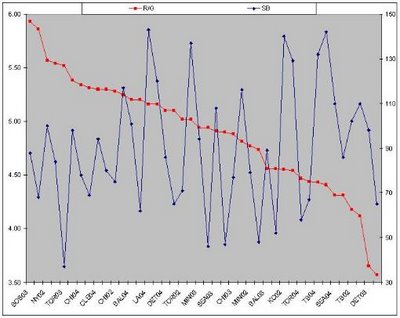


Let me translate this for you. The red line represents the runs per game figures of every team in the American league for the 2002-2004 seasons. They are in descending order, so the top left team is the 2003 Red Sox, who averaged 5.93 runs per game, and the bottom right team is the 2002 Tigers, who averaged just 3.57 runs per game. The scale for that line is on the left side of the graph.

The blue line is the number of stolen bases each team had, with the scale shown on the right side of the graph. As you can see, there is no real pattern to that line at all. If stolen bases were positively correlated to scoring runs – meaning that stealing lots of bases leads to scoring lots of runs – we would expect to see the blue line closely follow the red line. If the reverse was true – if high steal totals hurt run scoring – we would see a big “X”, with the blue line starting low on the left and moving upward as it moved right and crossed the red line.

We don’t see either. Instead we see a zigzag pattern. Some teams that stole lots of bases scored lots of runs, like the Angels in 2002 and 2004, while others scored few runs, like Tampa Bay in 2003 and 2004. Clearly, steal totals, in and of themselves, have no direct correlation to scoring runs.

Let me say that more plainly – steals alone are meaningless.

How about those bad things that your players currently avoid? Take strikeouts for example. Supposedly, striking out is one of the worst things a hitter can do. It would follow that any team that strikes out a lot will be prone to lower run totals, right? Actually, that’s not the case:
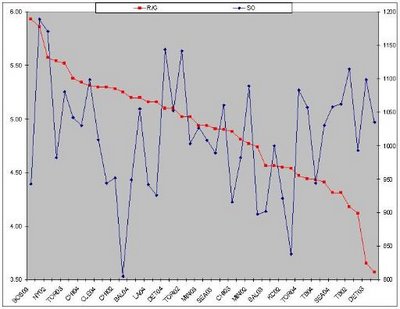
Pretty much the same graph as steals, isn’t it? The red line is runs per game again, exactly the same information as in the first graph. This time the blue line represents each team’s strikeout totals. Again we see the random zigzag pattern. Look at the top two scoring teams of the last three years, the Red Sox of 2003 and 2004. In ’03 they collectively struck out just 943 times. The very next year they added almost 250 K’s to that figure, yet they scored almost exactly the same number of runs per game (5.93 in ’03, 5.86 in ’04) and won the World Series. Last year’s champs had the highest team strikeout total (1189) in this three year period. The lowest total was the 805 strikeouts of the Angels of 2002, a club that also won the World Series and was fourth in the league in runs per game.

Again, there is no correlation between striking out and scoring runs.

Grounding into double plays is another traditional taboo for an offense. It’s generally considered to be even worse than striking out, because not only is the batter out but a baserunner is out as well. It’s commonly called a “rally killer”, so a high double play total must have a terrible impact on a team’s ability to score. At least, that’s the conventional wisdom. The trouble is that it’s just plain wrong. More graphs…
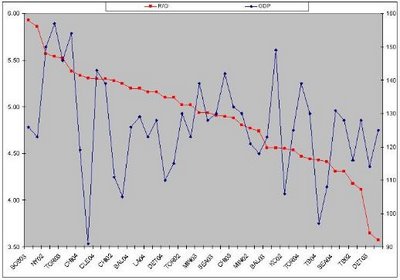
More zigzags. You’d see similar zigzags if I threw in graphs on sacrifices, or other “small ball” ratios, but I hope you get the point by now. These “little things” don’t directly translate to runs. That doesn’t mean they’re bad. No team should ever refuse to attempt any steals or sacrifices, or should wantonly whiff or ground into double plays. As individual events, a steal or sacrifice is still a valuable thing in some situations, just like a double play or strikeout is still a bad thing in certain circumstances. But, in totality, being good at these little things won’t result in more runs unless they supplement the real building blocks of offense.

And, as I said earlier, those building blocks are really simple – get on base and hit for extra bases. Batting average alone won’t get it done. It has a positive correlation to run scoring, but that’s deceptive for two reasons. First, batting average is really just a subset of getting on base. You can hit .300 all day long, and it will look great on the back of your baseball card, but if you never draw a walk and never get hit by a pitch, your on-base percentage will also be .300, and that just stinks.

The second reason it’s deceptive is because the correlation simply isn’t that strong when compared to the real drivers. Here’s the batting average graph:
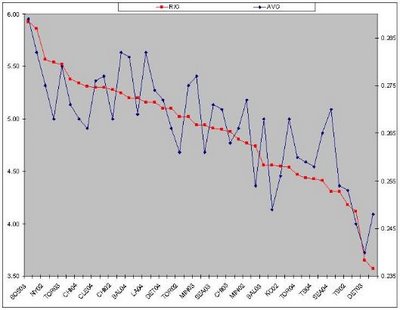
Obviously, there’s a relationship here, particularly when compared to the small ball graphs. There is a general trend indicating the as team batting average drops, so does team run scoring. But notice how that blue line hops up and down? Some of the swings are pretty far removed from the red run-scoring line, so the relationship here might not be the tightest. Compare it to the graph for on-base percentage:
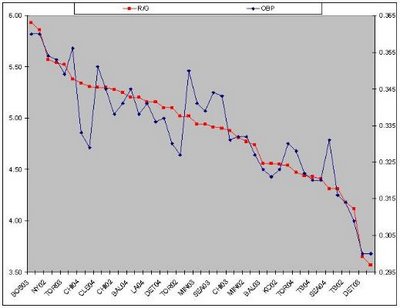
I could start throwing out some more obscure statistical terms like p-values and whatnot, but I don't want to confuse the issue. Trust your eyes and look at the graphs. This is obviously a much closer relationship. There are still swings between points, but at roughly half of the points the two lines are almost on top of each other. It’s obvious that the more a team collectively gets on base, the more runs they tend to score.

The same can be said for slugging percentage, which is the best representation of a team’s ability to hit for extra bases:
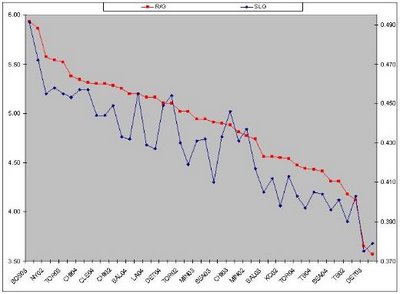
Again, there are some swings, almost as many as on the batting average graph, but overall it’s still a strong trend.

Now let’s put the two together. A relatively new statistic, OPS, is nothing more than a team’s (or player’s) on-base percentage added to its slugging percentage. When this number is compared to runs per game, the strong relationship is clear:
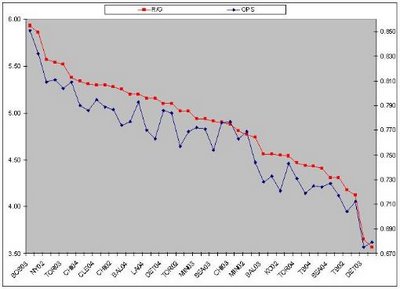
Reasonable swings from point to point, with no glaring exception to the general rule that the higher a team’s OPS, the more runs they will score. This is the strongest correlation yet, making it obvious that a combination of on-base ability and extra base power is the surest route to scoring runs in the American League.

Does that play out for your team this year? Sure it does. Just look at your team’s performance sorted by these various measurements. When the Royals draw two walks or less in a game, they are averaging 2.94 runs per game and have a record of 2-14 (.125). When they draw at least three walks in a game, their scoring average jumps to 4.53, and their record is 6-9 (.400). None of those marks are good, but clearly it’s better when the team is walking than when they aren’t.

The same trend reappears when we look at extra-base hits. When they Royals have only two extra base hits or less in a game, they average just 1.67 runs per game and their record – hold on to your hat – is 0-15. That’s a .000 winning percentage in case you were wondering. When the Royals get three or more extra base hits in a game, they average 5.63 runs per game and have a record of 8-8 (.500). See the pattern?

How about if we combine them? When they Royals draw at least three walks and have at least three extra base hits in the same game, they average 5.64 runs per game, and are a .545 ball club, with a record of 6-5. When they have the same three walks but at least 4 extra-base hits, they are a sparkling 5-1 and average 7.33 runs per game.

Now, if you have a researcher on your staff who is supposed to be looking at this kind if information for you, you might know that the Royals score better when they steal, too. Or when they have a sacrifice bunt, for that matter. That’s absolutely true, but don’t be misled. You see, in statistics there’s this thing called “confounding”, which is just a fancy term used to describe a situation where some other, unexamined factors are presents that make the thing you are examining look different than it really is. In the case of steals, for instance, I could make this completely true statement:

“In games in which the Royals stole at least one base, they average 4.56 runs per game. In all other games they average 3.36 runs.”

Absolutely true. But here’s the confounding part – look at those games more closely and you’ll find that in five of them the team also had three or more extra base hits. In the games in which they stole at least one base and also had three or more extra base hits, they averaged 6.4 runs (and posted a 3-2 record); in the games when they stole a base but had less than three extra base hits, they averaged just 2.25 runs (and posted a 0-4 record). So was it the steals that produced the runs or was it the extra base hits?

And let’s not forget the reverse side of the stolen base equation. The Royals have been caught stealing as many times as they’ve been successful. Your research might point out that in those games in which the team has been caught stealing at least once, they average more runs per game (4.09) than they do in the games where they weren’t caught stealing (3.50). Some might look at that from the small-ball perspective and say, “Well, it’s because by running we put pressure on the defense, so even though we got caught stealing we pressured them into mistakes in other parts of the game.”

I say, “Hogwash”. Look at the extra base hits again and you’ll see that in most of the games in which the team had at least one runner thrown out trying to steal, they also had three or more extra base hits. In those games, they average 5.25 runs. In the remaining three games, in which they were caught stealing at least once and also failed to manage at least three extra base hits, they scored just one run in each game.

Or look at it this way; In games in which the Royals had three or more extra base hits, but also wasted at least one out by being caught stealing, they were just 3-5 (.375) and scored 5.25 runs per game. In all other games when they had three or more extra base hits, but didn’t needlessly run into an out on the basepaths, they scored more (6.0 runs per game) and won more (5-3 record). Running just doesn’t help unless there’s some power to back it up, and running into extra outs, even when the team is hitting for power, actually hurts a team’s ability to score.

Here’s another one:

“In games in which the Royals laid down at least one successful sacrifice bunt, the team has averaged 4.33 runs per game. In all other games they have averaged just 3.45.”

So sacrifices are good, right?

Nope. In six of those nine games, the team also had three or more extra base hits, and averaged 5.00 runs in those games. In the three remaining games in which they laid down one or more sacrifices but didn’t have at least three extra base hits, they scored a total of nine runs, an average of just 3.00.

Or look at it this way; In games in which the Royals managed three or more extra base hits, but also gave away at least one out with a sacrifice bunt, the team still scored well – 5.0 runs per game – but posted a 1-5 record. In all other games in which they had three or more extra base hits but didn’t waste an out by bunting, they scored more (6.0 runs per game) and won more (7-3 record). So it should be pretty clear by now that these sacrifice bunts are dragging down the offense, not helping it.

And I guess that’s pretty much my point in all of this. The Royals collectively, and Tony Pena particularly, seem to have no real grasp of the things that lead to runs. Some of that might be attributable to the fact that the players collected here aren’t the biggest boppers in the world, so Pena and others feel like small ball is the only way to go. There is some truth to that, but not much. This collection of players wouldn’t be good no matter how well Pena used them, but his game strategies are actually taking precious runs away from a team that can’t afford it. Please, I beg you, stop him.

And as for your role in this, please try to keep some of these figures in mind as you put the team together. I mean, what, exactly, is Ken Harvey doing to help this team win? He has a .678 OPS comprised of a .389 slugging percentage and .289 on-base percentage. That’s awful. Do you realize that Mark Bellhorn, who is working for his fourth team, is generally recognized to be the worst hitter in the Red Sox daily lineup, regularly bats ninths and has failed to hit a home run this year, has a better OPS than Ken Harvey, who Tony Pena regularly bats cleanup? Do you realize that there are only three players on the Royals – Mike Sweeney, Matt Stairs and Joe McEwing – who get on base at a better rate than Bellhorn?

And recognize that this has nothing to do with money. Bellhorn makes only $2.75 million. Last year, when he was truly valuable, he made about $500,000. Both of those figures should be well within the Royals’ budget, and Bellhorn was available for any team to sign prior to last year. The Red Sox just happened to be smart enough to realize that they could have Bellhorn cheap, that his on-base ability would be valuable even if he did lead the league in strikeouts (which he did), and that his versatility (a switch-hitter who has played every position except pitcher and catcher) would actually save them money by allowing them to keep an inexpensive rookie, Kevin Youkilis, on the roster for most of the year and develop him slowly.

The Red Sox are currently the best at recognizing how offense really works. Yes, they have enormous resources, and they used them to sign Manny Ramirez and Johnny Damon. They also get to keep the players they develop themselves, like Jason Varitek. But almost half of that lineup is full of guys no one else wanted. Bill Mueller, Mark Bellhorn, David Ortiz, Kevin Millar - all free agents that the Red Sox signed for low dollars because they fit their style. The same goes for their homegrown talent, Varitek and Trot Nixon. Every one of those guys is patient and they all have extra-base power. That doesn’t mean they hit 30+ homers each year, though Ramirez and Ortiz certainly do. But you don’t need three or four guys hitting 30 homers each if everyone in the lineup is hitting 15 or more. And if everyone in the lineup is willing to draw a walk, they don’t have to wait for solo homers anyway; they can score with a walk and a double.

Those skills are affordable. The Red Sox didn’t pay most of those free agents much at all. Yes, they pay the likes of Manny, Varitek and Curt Schilling a lot of money, but the majority of the team is made up of players they Royals could have afforded. It’s about concentrating your dollars where it matters. Do you recognize that for the same money you are paying Terrence Long, you could have signed Jeromy Burnitz, who currently has a .518 slugging percentage for the Cubs? Do you realize that you could have a lineup of David DeJesus, David Dellucci, Mike Sweeney, Jeromy Burnitz, Matt Stairs, Joe Randa, Gregg Zaun, Mark Grudzielanek and Angel Berroa for the same amount of money you currently pay for a lineup of DeJesus-Graffanino-Sweeney-Stairs-Long-Marrero-Berroa-Buck-Teahen? That first group is comprised of four current Royals, one Royal who left in the off-season, Randa, and four guys who were free agents this year. They are hitting a combined .280, with a .365 on-base percentage and .479 slugging percentage. The second group – an actual Royals lineup several times this year - is hitting a combined .242, with a .304 on-base percentage and .397 slugging percentage.

Same money, wildly different results. And that’s because the first group includes players at most positions who either get on base a lot, hit for power, or do both. Even then, it can carry a couple of younger players who currently aren’t hitting that well, DeJesus and Berroa. We could have even substituted John Buck for Gregg Zaun, saved money compared to our actual lineup, and still posted impressive combined numbers - .270 average, .350 OBP, .462 slugging.

I hope you are beginning to see how this works. Forget about speed and whether or not they strikeout a lot. Draft or sign hitters who are patient and who drive the ball when they make contact. If they can run and field on top of that, great. If not, sign them anyway, because it’s a whole lot easier to find a cheap defensive specialist than it is to find someone who walks 80 or more times while he’s hitting 20+ homers. You can carry a couple of field-first guys in the lineup if you are getting the production you need elsewhere. If you’re not, it doesn’t matter how well the team collectively catches the ball, or runs or bunts, they won’t score.

And in the American League, if you can’t score, you can’t win. I sincerely hope these numbers make that abundantly clear.

If they don’t , God help all of us poor Royals fans.

Regards,

Paul White

Tuesday, March 08, 2005

The 2005 Kansas City Royals

Ever since the Royals gave new meaning to the term “broke from the gate” in early 2004, it has been assumed by most observers that this team is due for yet another major re-building effort in 2005. That opinion was confirmed with the trade of Carlos Beltran in June, in exchange for three prospects that only die-hard fans had ever heard of.

But is that view correct? Will the Royals really spend another season toiling toward oblivion? LetÂ’s take a closer look.

Before doing anything else, letÂ’s look at the American League Central, with an eye toward determining whether last yearÂ’s statistics are accurate measures for each team. In reality, the final standings in 2004 looked like this:

Minnesota 92-70
Chicago 83-79
Cleveland 80-82
Detroit 72-90
Kansas City 58-104

Based upon that, it looks like the Royals were 14 games worse than the next-worst team in the division, Detroit, while lagging a whopping 34 games behind the division champs. But those numbers donÂ’t tell the entire truth. The reality is that the gap in run differentials for the division wasnÂ’t that wide. As I have written many times, along with hundreds of others, run differential is a more important measure in judging a teamÂ’s quality that win totals, which are often swayed in one direction or another by luck, or fate, or whatever you want to call it. That doesnÂ’t exist in the raw run differentials. Since those differentials are regularly used to project a teamÂ’s record, what do the differentials of the divisionÂ’s teams look like for last season? Here they are, courtesy of baseball-reference.com:

Minnesota 87-75
Chicago 84-78
Cleveland 81-81
Detroit 79-83
Kansas City 64-98

That changes the starting point a great deal. Minnesota played five games over their heads last year, a significant amount. And while the White Sox and Indians played essentially as expected, both the Tigers and Royals under-performed to a significant degree. The Tigers werenÂ’t really a 72-90 caliber team; their run differential was actually fto Cleveland toClevelandÂ’s. And while the Royals were clearly still at the bottom of this food chain, the team was of slightly higher quality than their actual record. They were still far behind the next closest team, but instead of being 34 games worse than the division winners, they were really about 23 games worse.

That 11-game swing is enormous. It indicates that the division as a whole was much more tightly bunched from top to bottom than won-loss records alone would indicate. From top to bottom, 23 games separated the projected records of the division’s best and worst teams. To compare, among all other divisions in baseball, only the American League West was more tightly bunched, with a 22-game spread in the projected records between first place and last place – and they have only four teams.

So already we see two things in the RoyalsÂ’ favor from 2004:

  • While they were still bad, they were actually significantly better than their won-loss record would indicate.
  • Their division is perhaps the most winnable in baseball.

In addition, the RoyalsÂ’ schedule shifts in their favor for 2005. Last year, in the 18 inter-league games they played, the Royals faced teams with a combined projected winning percentage of .525. In 2005, their inter-league opponents combined for a projected winning percentage of .509, so that may be a game or two in Kansas CityÂ’s favor. Plus, in any given year, the Royals are guaranteed of playing every AL team outside their division at least 6 times each. Add that to their division games and their 18 inter-league games, and there is always an additional 14 or 15 games against non-divisional opponents in the American League that must be played to reach a full 162-game schedule. In 2004, the RoyalsÂ’ played those extra 14 games against teams against teams that projected to a combined record of about .500 (.498 to be exact). In 2005, the Royals play 15 extra games against non-divisional AL opponents because, for some strange reason, Major League Baseball scheduled only 18 games between the Royals and White Sox, instead of the 19 games the Royals play against all other teams in the AL Central. Those fifteen games come against teams that projected to a combined record of .484 last year. ThatÂ’s another game or two could swing in the RoyalsÂ’ favor.

We can add up all of these favorable issues as follows:

58 actual wins in 2004 +6 wins below projected that the team should have won in 2004 +3 wins for more favorable 2005 scheduling.

That brings us to a total of 67 wins for 2005 even if the Royals didnÂ’t change a thing during the off-season.

But, of course, things did change. Carlos Beltran is gone. So is Joe Randa, and Benito Santiago and Darrell May and a few others. But with the exception of Beltran, most of the losses arenÂ’t that bad. Joe Randa was a league-average third baseman, which certainly has value, but not as much as sentiment would indicate. Benito Santiago didnÂ’t play much for the Royals at all last year, and the same goes for Juan Gonzalez. May pitched a lot, but he was terrible.

Conversely, the Royals have a lot more parts this year that were simply missing for large portions of 2004, in some cases for the entire season. Runelvys Hernandez, for instance, combined to throw 166 ingoing 11n 2002 and 2003, going11-9 with an ERA+ of 113 in that time (meaning his ERA was 13% better than the league average). He missed the end of 2003 and all of last season with an injury, but is now back and throwing well by all accounts. If he posts the same kind of numbers noted above, he will be a major upgrade over Darrell May, who, in just 20 more innings than Hernandez could be expected to throw, surrendered 43 more runs, 33 more earned runs, 68 more hits and 21 more home runs, while posting an ERA+ figure of 79 (thatÂ’s 21% worse than league average). Then factor in an added 50 or more innings from Zack Greinke, who started 2004 in Omaha, and suddenly the staff is seeing roughly 220 innings thrown by pitchers who were better than the league average, instead of having those innings taken up by May or Chris George. In 228 innings in 2004, May and George combined to surrender 169 runs. Greinke and Hernandez, if they pitch to expectations, would be expected to allow just 111, an improvement of 58 runs for the team. All other things being equal, that change alone raises that Royals projected winning percentage from .397 in 2004 to .426 in 2005, a difference of five additional projected wins.

Add those wins to the more favorable schedule and the performance to expectations, and suddenly the Royals look like a team that should be expected to win 72 games. ThatÂ’s a winning percentage of just .444, and isnÂ’t all that good, but it represents a quantum leap of 14 added wins over the 2004 total.

To be fair, there will be reverses. Having Beltran out of the lineup will hurt, as will the loss of Randa before his replacement, Mark Teahen, is ready for the big leagues. But the team will now have Mike Sweeney healthy, as well as Tony Graffanino. More importantly, they will have some of the youngsters available for the full season. David DeJesus, Calvin Pickering and John Buck all produced solid numbers in limited action in 2004. They are all now projected to play full time (or at least, I pray that the Royals allow Pickering to play full time). Projecting their 2004 performances over 150 games (135 in the case of Buck since catchers get more time off), reveals that their presence in the lineup every day should easily make up for the loss of both Beltran and Randa.

  • DeJesus - .287 AVG/.349 OBP/.404 SLG/.753 OPS; 91 runs, 11 HR, 61 RBI
  • Pickering - .251 AVG/.349 OBP/.510 SLG/.859 OPS, 93 runs, 31 HR, 115 RBI
  • Buck - .238 AVG/.284 OBP/.431 SLG/.715 OPS, 77 runs, 26 HR, 64 RBI

And none of those numbers account for their continued improvement now that they have a half-season in the majors under their belts.

Additionally, the additions of Eli Marrero and Terrence Long to play the corner outfield positions will help the offense. Neither is better than an average hitter for his position, but that is still a vast improvement over the collection of stiffs who patrolled left and right fields or the Royals in 2004. Consider:

  • In 2004, Royals left fielders combined to post an OPS of .608. That was the lowest figure for left fielders in all of baseball by 119 points. The only teams that posted a lower figure at any position (except pitcher) were the Brewers shortstops (.607) and catchers (.590), the Marlins catchers (.599), and the Mariners catchers (.586). Note that all of those are defense-first positions. And speaking of pitchers, the IndiansÂ’ staff, in admittedly brief time at the plate, posted a better combined OPS, .619, than the Royals left fielders. Pitiful is the only word that springs to mind.
  • Royals right fielders combined to post an OPS of .682, also the lowest in baseball, this time by 34 points.

Marrero and Long, the two players most likely to collect significant plate appearances at those two positions in 2005, had OPS marks of 894 and 755, respectively in 2004. Even if each of them regresses this season to post just their career OPS mark, .717 for Marrero and .730 for Long, each still represents a significant upgrade. Look at it this way – Royals left fielders combined for 13 homers and 59 RBI in 583 at bats in 2004. Meanwhile, a platoon of Marrero against lefties and Matt Stairs against righties combined to hit .310, with 19 homers and 71 RBI in just 451 at bats. Extrapolate that out to 583 at bats, and the duo could reasonably be expected to combine for 25 homers and 90 RBI. Both figures would have been squarely in the middle of the pack last season. The Royals would settle for that, no questions asked.

Overall, itÂ’s not unreasonable to expect that both the RoyalsÂ’ offense and pitching will be better in 2005. ThatÂ’s not saying much, because both were awful in 2004, but it allows us to set goals. As demonstrated above, simply eliminating Darrell May from the equation, with Hernandez taking over the bulk of his innings, and having Greinke for a full season, should allow the Royals to shave nearly 60 runs off the total they allowed in 2004. Even in those two fail to perform quite to their billing, they are an improvement. Add in a resurgent Jose Lima and a settled, healthy bullpen, and it would be fair to project the Royals to allow about 75 fewer runs in 2005. That would be 830, a vast improvement but still a mark that would have been good for just a tie for 9th in the AL last season.

The RoyalsÂ’ offense should also be able to improve upon their 11th-place finish of 720 runs scored, Beltran and RandaÂ’s departures notwithstanding. They project to be improved at both corner outfield positions (Marrero/Stairs and Long), catcher (Buck for a full season), first base (a healthy Sweeney), DH (Pickering for a full season), and second base (a healthy Graffanino and/or emerging Ruben Gotay). They are likely to drop off significantly at third base, and somewhat in center field, but they have solid prospects at each position. At shortstop, they are likely to get similar results or even a slight improvement if Angel Berroa returns to his rookie form. Overall, there should be modest offensive improvement, say 30 runs, giving them a projected total of 750.

A run differential of 750 runs scored and 830 allowed projects to a winning percentage of .454, or a 74-88 record over a full season. Even if the team performs below their run differential again, they are a good bet to hit 70 wins, an improvement of a dozen over 2004. In all likelihood, that would still be good for last place in the AL Central, but it would be an enormous stride forward. And, more significantly, it would be accomplished mostly with emerging young (and inexpensive) talent.

In other words, it would be true “re-building” instead of the facsimile we have witnessed here in Kansas City over the past decade. Wouldn’t that be refreshing?

Monday, February 28, 2005

Bonds Should Be Ashamed

Once the steroid issue fully reared its head, complete with leaked grand jury testimony and name-dropping from has-been players, it was only a matter of time before someone dropped the other shoe. The shoe that always gets dropped when a controversial issue arises in sports.

I’m talking about the race card, of course. And we now have it woven into the steroid issue courtesy of the one guy involved who has no business playing it – Barry Bonds.

To be fair in letting you judge my comments on this issue, let me state my position up front as clearly as possible. I believe steroids are the worst thing to come along in baseball since gambling. It robs the game of its integrity and obliterates the one thing about the sport that made it unique; its long history of comparing players across eras. How can anyone now measure Rafael Palmeiro against Harmon Killebrew, or Gary Sheffield against Orlando Cepeda? We can’t, because we don’t know how much steroids may have inflated their performance.

And let’s clear up one other aspect of this that some try to hang their hats on. No, using steroids wasn’t against the rules in baseball until relatively recently, but they certainly were illegal to obtain and use without a doctor’s prescription. Any player who did so committed a crime, whether baseball wants to recognize it as such or not. Criminal activity is addressed in standard player contracts, and purchasing illegal steroids would have qualified.

While we’re at it, let’s also dismiss the ridiculous assertion that steroids don’t help with baseball activity. That’s patently false, as anyone who took 11th-grade science can attest. Even if no one can prove the assertions that human growth hormone improves eyesight, and therefore hand-eye coordination, leading to improved contact and pitch identification, it’s indisputable that steroids enhance the development of muscle mass and muscle performance. This has been the case for years. Just refer to Ben Johnson in the 1988 Olympics. Well, as Ms. Berry would have told me back in high school:

Force = Mass x Acceleration.

If you have artificially enhanced muscle mass, you can swing a larger bat with more speed than non-juiced players. Both mass and acceleration have been enhanced by the steroids, equating to more force applied to each batted ball. Before Barry Bonds or anyone else decides to argue to the contrary, they should crack open an old textbook first.

So that’s my view – steroids are a blight on the game, their use was illegal in society if not specifically in baseball, and they have an absolute affect upon players’ performance on the field. Players who used them have disgraced both themselves and the game.

And I don’t give a fiddler’s fart what color they are.

I am certain that black players still generally face more difficult circumstances in baseball than their white counterparts, even today. I know that the majority of black players in the game’s history faced even worse circumstances, ranging from open racial slurs to death threats. As Bonds suggests, the legacies of many black players really have been unfairly tarnished, in some cases, by media members who judged them by their skin color rather than by their accomplishments or talents. I have written about that very subject in regard to Jim Rice’s treatment by the media and fans in Boston. It was, in a word, shameful. It is entirely proper that people make this point when discussing the perceptions of black ballplayers throughout history.

But not when it comes to steroids. This isn’t an issue of the players involved being unfairly targeted by bigoted fans or reporters. Those facing the primary criticisms are those who have admitted using steroids, have been directly implicated in using steroids, or have provided us with ample anecdotal evidence in terms of altered appearance and sudden jumps in performance to speculate about their use. The three players in the absolute spotlight of this attention – Barry Bonds, Jose Canseco, and Jason Giambi – fit all three criteria. These are not innocent bystanders, unfairly questioned without evidence. These are men who have either openly admitted to using steroids, or reportedly admitted doing so to a grand jury. In short, they cheated, all of them.

Each of the three is of a different ethnicity – one black, one latino, one white. Others who have been mentioned also span the races that make up the vast majority of ballplayers. Gary Sheffield is black. Juan Gonzalez, Rafael Palmeiro, and Ivan Rodriquez are latino. Roger Clemens and Mark McGwire are white. All we are missing is Asian players.

It seems pretty clear that there is no racial component to steroid use at all. And I don’t see any extra focus being placed upon Bonds that isn’t warranted. After all, he has widely been labeled the greatest player ever, or at least is up for consideration for that honor. He’s on the brink of breaking baseball’s most prestigious record. Sorry, Barry, but that’s going to garner a lot of attention. Throw in the possibility that he’s going to break that record because he used banned substances for several years, and of course the attention is going to be overwhelming.

None of that should have been unexpected to Bonds, and he had a reasonable example of how to handle the media crush if he had watched Giambi’s forthright (if somewhat aborted) apology and ongoing concentration on getting ready for the season. Would a simple, “Sorry, I can’t discuss anything to do with the trial”, have been so demanding? It’s not the answer the media or public wants, and many certainly would have used such a response to crucify Bonds for failing to be forthcoming. No one ever said this situation wasn’t going to be difficult to handle. But it’s a situation of Bonds’ own making, and he could have chosen to handle it in the least controversial manner possible.

Instead, he went down the opposite path, choosing to inflame the situation even further by implying he’s being treated unfairly because of his color. And that the media are all liars, and that he’s had it harder than Babe Ruth, and that steroids don’t help you hit a baseball anyway, and that he doesn’t even know what cheating is, and on and on. It was a rant, one that was obviously contrived to deflect the conversation toward anything but the real topic – that Bonds knowingly cheated the game.

To hear Bonds tell it, the media is supposed to just let the matter drop because Bonds is black. Or perhaps they are supposed to ask him only as many questions as Giambi has had to face, despite his more renowned status in the game’s history. That’s ludicrous, of course. To do so would be to flaunt all journalistic ethics.

And yet, that’s exactly what some are doing. Jason Whitlock used his most recent column in the Kansas City Star to call the media’s treatment of Bonds a “witch hunt”, as if the man has done nothing wrong. Howard Bryany, a columnist for the Boston Herald, appeared on ESPN’s “Outside the Lines” on Sunday and also agreed with Bonds that his race is a factor in how this story is being reported.

They, and others like them, have allowed Bonds to succeed. The issue is no longer whether he cheated the game, it’s whether or not the media is racist. Bonds’ apologists have allowed him to manipulate them for his own purposes. They have allowed this discussion to become O.J. all over again. Black people are lining up to support the insupportable, Bonds, while any whites who hold the opposite view have to live with being labeled racists for doing their jobs. Dusty Baker went so far as to draw a direct comparison between Bonds’ situation and O.J. Simpson’s. He was quoted in the Chicago Tribune as saying:

"I mean, O.J. was found [not guilty] but in the minds of a lot of people he was still guilty. Why do we have this system in place here if you're going to be exonerated for something and still be guilty?"

Baker has allowed himself to conveniently forget that O.J. Simpson was found responsible for the death of his wife and her friend by a court of law. Simpson lives under the ongoing financial cloud of a multi-million dollar judgment against him, yet Baker acts as if Simpson is somehow blameless. All he remembers is the criminal trial, and the rejoicing of most blacks in this country at the not guilty verdict. And Baker certainly isn’t alone. It’s Baker, and others who share his views, who are guilty of viewing this issue solely through the prism of race, not the reporters who question Bonds. It’s they who conveniently forget the facts about O.J. and the facts about Bonds simply because they are black.

And why? While there are certainly multitudes of black athletes who have been wronged in various ways because of prejudice, Barry Bonds can hardly claim to be among them. He grew up the child of a famous millionaire major leaguer player. He was endowed with enormous financial and physical blessings for his entire life. This wasn’t the child of a sharecropper from Alabama, who was spit upon in the bus leagues or forced to suffer through the inferior quality of segregated restaurants, schools, bathrooms and hotels. He’s a child of privilege. To play the race card in his favor is patently ridiculous, and it’s a disgrace to all black ballplayers who did suffer the ignominy of racist behavior.

I could use any number of other black players as an example, but I’m going to use Jim Rice because I know his situation better then most. Rice had real disadvantages because of his skin color. He grew up in a working class family in the South, and had to learn real work at an early age. His high school coach threw him off the team his sophomore year for a lack of hustle, and only allowed him back on when apologized and begged for a second chance. By his senior year, once he had made a reputation as the best player to come along in years, the school board re-wrote the high school boundaries to include his street in the area that attended the white high school. Once he graduated, the boundary shifted back again.

Rice always had to work a job, and took his responsibilities to his employer so seriously that he almost never played major league ball at all. With several major league scouts waiting for him to appear at an American Legion game, Rice wouldn’t leave his job on a loading dock because his replacement hadn’t arrived yet. Consequently, many scouts left before seeing him, and most who remained labeled him lazy because they didn’t know he was laying down in the dugout between innings because he had worked a full shift on the dock before the game.

When Rice finally reached the majors, his arrival coincided with the racial conflicts in Boston regarding busing. He had to watch buses full of black children being stoned by Irish Southies on the evening news every night, then face the microphones of acerbic media members named Ryan, Sullivan, Murphy, Callahan or McDonough. He had to endure the loneliness of having no black teammates for four years worth of games during his career, and had to listen to some of the home fans in Boston calling him “Uncle Ben” from the left field seats. When he returned to South Carolina in the off-season to play a little golf, he was told to his face that the only reason he was allowed to play the nicest course in town was because he was a famous ballplayer. Otherwise, his skin color would have confined him to the public course in town.

And how did Rice react to this treatment? Did he play the race card? Did he cheat? Did he inject himself with steroids to help recover from the injuries that forced him to retire at 36? No, because his parents and his coaches taught him personal responsibility early in life, a lesson he never forgot.

Now, years later, Rice can’t get elected to the Hall of Fame, partly because he was portrayed in the media as a jerk and partly because he didn’t cheat to extend his career. He took the abuse with stoicism and suffered the resultant damage to his reputation. He took the responsibility to play the game hard and with honesty, and wouldn’t allow himself to cheat the game with illegal drugs. Bonds has done Rice, and countless others who preceded him, a dual disservice. First he cheated the game and cheapened their accomplishments with artificially bloated statistics, then he cheated their legacy for facing down racism by implying that his cushy upbringing compared to theirs.

What Bonds’ apologists have done is a further disservice. They have lent legitimacy to his ludicrous complaints, and allowed Bonds to escape responsibility for his actions. Both Bonds and his apologists should be ashamed of themselves.

Tuesday, February 22, 2005

The Empty Glass

Fair is fair.

I am as frustrated about the lack of off-season improvement from the Royals as any fan, but I’m going to look at this from a different perspective. Rather than look solely at the baseball aspects of this stagnation, let’s judge it from David Glass’ view. After all, he’s not a baseball guy, and readily admits it.

No, David Glass is a businessman. His purchase of this club and every decision he’s made regarding the team since that purchase, has been driven with business in mind. Period. And, in that case, it’s only fair to allow that he won’t run the Royals on his personal nickel. It has to be a self-sustaining enterprise, so I have no problem with his long-standing direction to Allard Baird that the club’s payroll must be in line with its revenues.

So, if we are to grant Mr. Glass this point, it’s only fair that we judge the club as a business. Is it being run well? Are they reaching the goals of all good businesses, namely to make money?

Let’s look at the Royals strictly from that cold corporate perspective. What does it look like just as a business enterprise? We all know about the shortcomings they face; both the club and Bud Selig are more than happy to trumpet the woes of small-market teams. But what are the Royals’ strengths? What can be used to offset the disadvantages inherent in baseball's current economic system?

  • They have a local monopoly. There’s no other major league ball club within 400 miles.
  • They’re cheap. Compared to the Chiefs, KU basketball, or other major league clubs, a night with the family at Kauffman Stadium is very affordable.
  • They have a loyal fan base. This isn’t Montreal, where the fans will run and hide if the team falters. There is a hard-core group of fans that will always head out to the ballpark, no matter how bad the team performs. On top of that, the not-so-loyal followers proved in 2003, when the club contended for much of the season, that they will return to the park to watch a good product.
  • There is finally a decent base of young, inexpensive talent on the big league club. Most teams in baseball would like to have David DeJesus, Angel Berroa, John Buck, Zack Greinke, Jeremy Affeldt, Runelvys Hernandez, Denny Bautista, Ruben Gotay, Calvin Pickering and many of the bullpen arms. There are even some serviceable trade bait parts that other teams would find attractive at the trading deadline – like Mike Sweeney, Matt Stairs, Scott Sullivan, Eli Marrero, Terrence Long, and Tony Graffanino.
  • They have a workable stadium. No, Kauffman Stadium isn’t chuck-full of luxury suites and wide concourses. But the playing field is beautiful, the seats are comfortable, the site-lines are outstanding, and it can get very loud when it’s a good game. It’s a nice home-field advantage.
  • They will always have an extra source of revenue from Major League Baseball because they are a low-revenue team. The club had a small-market team’s worst nightmare in 2004; the highest payroll in the club’s history coinciding with the worst record in club history. And you know what? They still made a profit. About $5 million net profit, to be exact, thanks to shared revenue and luxury tax from MLB. Most businessmen would agree that it’s not a bad deal if you can get it.

There are other strengths, but you get the point. The question, then, is whether or not they are leveraging their strengths to get the maximum amount of success despite their weaknesses. Are they, in short, being run as a sound business?

The answer is a resounding No.

What Mr. Glass should be able to see, being a good businessman, is that, in baseball, performance on the field directly translates to profits for the team as a business. More wins equals more tickets sold, which equals more beer and hot dogs purchased. It means more demand for Royals merchandise, and greater demand for advertising space on stadium billboards, scoreboards, drink cups and outfield walls. It means more television viewers and more radio listeners, which translates to higher demand for radio and TV advertising time for the broadcasters, giving the team leverage on negotiating the rights to air those broadcasts. Winning is simply good business.

What’s more, winning, to a degree, is a self-perpetuating enterprise. It makes running your business easier. Winning means that young players will want to be drafted by the Royals, and that veterans will want to come to Kansas City through free agency. It means good scouts and front office personnel want to come to the club, or stay with them if they are already here. It means minor league clubs will want to partner with the Royals, and local communities will want to keep them around. It means, ultimately, forcing Kansas City to replace Kauffman Stadium with a more modern park that will generate even more revenue.

That is what winning does. And, so far under the David Glass regime, it’s the one thing the team has failed miserably to do.

Sure, it’s harder to win these days, as players are costing more and more to obtain or keep. Like in most businesses, being successful in baseball is hard. To quote Tom Hanks as Jimmy Dugan:

“It’s supposed to be hard. If it wasn’t hard, everyone would do it. The hard is what makes it great.”

He also said, “There’s no crying in baseball”, and truer words have never been spoken. And for that reason, I don’t want to hear about the troubles involved in putting a winning team on the field in Kansas City.

What I want is results. My real job is with General Electric, and as both an employee and a stockholder, I absolutely expect my hard-invested money to be put to good use. When GE’s stock started diving toward the end of Jack Welch’s tenure as CEO, I was one angry investor. How dare they take my money, give me limited investment options in my 401(k), which basically forces me to buy GE stock, and then allow the stock to drop from $60 per share to $20 in a two-year span. What a raw deal.

As a paying customer of the Royals, someone who pays my hard earned money to attend 6-10 games each year, always with at least one member of my family and often with all of them, I’m the equivalent of a stockholder. I give you my money and I expect results, just like I do with GE.

To date, those results just haven’t been there. Instead, all my money has purchased me is a team picked dead last in ESPN’s power rankings for the upcoming season. A team that proved it can turn a $5 million profit with a $47 million payroll, and then promptly cut that payroll by about $10 million just as revenue-sharing dollars are likely to go even higher. At this level of spending, it’s entirely possible the Royals could turn a $20 million profit in 2005, which is certainly great for David Glass, but it doesn’t do much for me as an investor. Why hasn’t that $20 million been spent on more major league talent? Or, since I will grant the point that it’s hard to recruit veterans to the team in its current state, why have we heard nothing of the club investing that money in minor league facilities or instructors, or in scouts and player personnel staff, or in development and acquisition of international free agents in Latin America?

In short, where is the return on my money?

I’m happy to give you a break, Mr. Glass, and judge the Royals’ performance strictly as a business. Like I said, fair is fair.

But, in case you’ve never learned this lesson Mr. Glass, in baseball, winning is good business. And, no matter what your balance sheet might say, your business is nearly bankrupt.

An Apology

My sincere apologies to Jayson Stark are in order. And here I am to offer them.

If you recall, I ripped Stark pretty well in recent years for his failure to support Jim Rice for the Hall of Fame. Ordinarily, I wouldn’t object to such a stance, because I have never been such a Rice zealot that it clouded my objectivity. Rice is a borderline guy, I admit it. Rational people can object to his election.

But Stark’s objections we so pat, in my view, so lacking in real supporting facts, that I felt compelled to call him out and email him with my rather expansive thoughts on the matter. To his credit, Stark always replied thoughtfully and politely, no matter how lengthy or pointed my commentary. Then came last year’s ballot, when he not only kept Rice off his ballot again, but reiterated all of his hollow objections again, without any new or more detailed reasons to explain why he wouldn’t be swayed. I wrote at the time that it seemed clear Stark was a lost cause, that he had put the Jim Rice question to rest in his own mind, after years of struggling with Rice’s candidacy. I wrote him off and dropped my efforts to persuade him away from The Dark Side.

It turns out I was wrong. This year, when his latest ballot was published on ESPN.com,Stark’s views had finally changed. After ten years of deciding Rice wasn’t worthy of the Hall of Fame, Stark changed his mind and voted for Rice.

When I saw that, I sent Jayson a quick email, thanking him for being as open-minded as he always said he would be, and apologizing for labeling him a lost cause. True to form, Jayson sent a gracious, polite, thoughtful reply.

This is the kind of thing that gives me hope, not only for Jim Rice’s chances of ultimately being inducted into Cooperstown, but for life in general. I don’t know why, because this is a pretty trivial matter in the grand scheme of things, but it does just the same. Maybe it’s the fact that Stark turned out to be an honest man. He said he would always be open to dissenting views, and he was true to his word. That’s rare in the world of big time sports these days, where athletes regularly say it’s not about the money just before they accept the biggest contract offer, or claim they didn’t take steroids, or didn’t slap the ball (hear that A-Rod?). Stark’s honesty was a pleasant surprise.

So here’s to you Jayson. Please accept my sincere apologies for giving up on you.

Now, about your views on Alan Trammell…

Monday, November 22, 2004

World Champ Thoughts

Gosh, where to begin?

Well, the Red Sox are the World Champions. That might be a good place to begin.

No, seriously.

It still looks strange in writing, I must admit. I think it has finally fully sunk into my brain that the dreaded fear of all living Red Sox fans - that they would die before the Sox won the World Series - has now been removed. It's going to be nice to just be perceived as normal fans of a normal team from now on. That whole "Sox fans love to be miserable" nonsense isn't going to be missed.

Though I think I now have my brain wrapped around this new outlook on my team, I think it's still going to be a while before I can articulate it well. So, for now, here are a few more random thoughts that I'd like to share to plug the gap since I last updated this site.

* Most Yankee fans are jerks. Since the Sox have won, I have seen all of the following arguments made by Yankee fans as a means to downgrade the Sox's achievement: The Wild Card system needs to be changed, Schilling wasn't actually hurt, it hurts more to lose as a Yankee fan since they expect to win so much more than other teams, since they won 101 games during the regular season and the Sox won just 98 they are still the better team, Schilling's contract clause is an illegal gift from MLB and without it he wouldn't have even pitched for the Sox, Varitek is a horrible defensive catcher based upon his one ALCS inning catching a knuckleballer, Johnny Damon throws like a girl, the entire team's hair is too long, they arenÂ’t serious enough and don't respect the game, Francona is lucky they won since he let the clubhouse get out of control, the new ownership wouldn't even own the team if not for Bud Selig's illegal intervention, John Henry practices insurance fraud, and on and on. What a bunch of crybabies. And they said Sox fans were whiners.

* One important exception to my observation - Dave Rasmussen. You don't know him, he's just a guy I work with, but since he's a transplanted Yankee fan from Jersey and I'm a transplanted Sox fan from Boston, we have a friendly wager each year on which team will win the division. The winner gets his choice of choice cut steaks or lobster flown in from the loser's home state. Since the Yankees finished first again this year, Dave won the bet, but he said he couldn't decide which option he wanted, so we agreed to let it sit for a while. We had a follow-up bet on the ALCS, which I won, and over that lunch I asked him again if he knew whether he wanted surf or turf for winning the regular-season bet. Again, he said he couldn't say yet. Finally, when the Sox won the Series, he came to my desk to congratulate me, and as he was walking away turned back to tell me he finally knew what he wanted from our bet.

"Fly in two lobsters from the Cape. But don't deliver them to my house. Ship them to yourself instead, then take them over to share them with your Dad," Dave said. "He's been waiting a long time to celebrate the Sox."

Dave Rasmussen, a Yankee fan with class. Too bad there aren't more like him.

* Scott Boras is trying to ruin baseball. Aren't owners already stupid enough? They have made innumerable idiotic decisions that have broken fans' hearts and hurt the game. Do they really need a guy controlling all of the best free agents actively encouraging them to be even more stupid? Because, make no mistake, a 10-year contract for anyone, even someone as good as Carlos Beltran or Adrian Beltre, is stupid. A 5-year contract for a soon-to-be 33-year old catcher, Jason Varitek, is also stupid. Don't get me wrong; if I was a player, I'd probably hire him. But as a GM, I would probably take the Kenny Williams stance and vow never to sign one of his players. Who needs that headache?

* Let me explain just how stupid it would be for any team to agree to the contract terms Scott Boras has floated for Varitek. He claims that Varitek is the exception to the rule about catchers' aging patterns because any catcher that proved he can play at the level Varitek did in '04, at age 32, tends to continue that level of performance into their late-30s or early-40s.

To do a sanity check on Boras' argument, I looked at all catcher's who had roughly the same success, or better, at age 32 as Varitek did this year, and then looked at their next five years, the length of contract Boras wants. The tool I used was a stat call RCAA, which stands for Runs Created Above Average. It was created by a guy named Lee Sinins and compares how many runs that players created as a hitter to the average at his position.

Even though Varitek had 19 RCAA this year, I set the age 32 floor at 15 RCAA, both to make sure I pulled in enough players who were similar and to make sure Fisk was included since Boras specifically mentioned him as a comparison to Varitek. Then I threw out active players (Mike Piazza, Ivan Rodriguez, Javy Lopez) because we don't know yet what their trends will be.

That left 15 catchers with at least 15 RCAA at age 32 - Bill Dickey, Elston Howard, Mickey Cochrane, King Kelly, Gene Tenace, Walker Cooper, Darren Daulton, Ernie Lombardi, Ron Hassey, Ed Bailey, Joe Ferguson, Chief Meyers, Ray Mueller, Roger Bresnahan and Fisk. That would give us 75 potential seasons from ages 33-37 for these guys.

Right off, we see a huge hole in Boras' reasoning, because instead of 75 seasons to examine, we only have 61. Over half of these guys, eight to be exact, retired before age 37, when Varitek's proposed contract would expire. So 14 seasons of a possible 75 were never played. (It should be noted that one of those, Mueller's age-33 season, was lost to WWII, not retirement. He came back and played at ages 34-37.) If Varitek follows the pattern, there's a 50% chance or more that he won't be around at the end of the contract.

Boras' argument looks even worse when we look at the 61 seasons actually played. Of those, just 11 matched or exceeded the 15 RCAA threshold, meaning that following the trend would give Varitek just a 15% chance of having a single season during that 5-year contract that could equal his output in 2004. Even more disturbing, 27 of the 61 seasons played resulted in negative RCAA. nother 5 were at zero. Add that to the 13 seasons that were never played due to retirement, and suddenly 45 of 75 seasons (60%) were either never played or were played at an average-or-below level of offensive output for a major league catcher.

All of this means that if Varitek is as similar to these players as Boras' represents, during a five-year contract he is likely to have just 2 years of that contract with offensive output better than average, only one of which will match 2004, and will retire after four years.

That doesn't sound like a $55 million bet the Red Sox, or any team, should take.

* Let's also put to rest this sham argument that the Yankees were actually a better team because they won three more games during the regular season. If the two clubs played identical schedules, that argument would be more sound. Faulty and flat out wrong, but with a little more substance than in the world of unbalanced schedules that we live in.

But it's wrong because the Sox not only played a tougher schedule (opponents' winning percentage of .505 compared to the Yankees' .499), but also because the Sox performed better against good teams, while the Yankees' lofty record was based upon destroying bad teams and treading water against the good ones.

Against teams with winnings records, the Red Sox were 42-31, a winning percentage of .575. The Yankees, on the other hand, were just 35-30, a winning percentage of .538. Even more telling, the Yankees were extremely lucky to have a winning record at all against good teams because they were outscored in those games, 341-319. Read that again. Against teams with a .500 record or better, the Yankees were outscored by a third of a run per game. They achieved their 101 wins largely because they lucked into a few more wins than they deserved against good teams and beat the hell out of the bad ones.

The Yankees projected record, based upon their run differential, was 89-73, which means they won 12 more games than they should have. Meanwhile, the Red Sox were exactly as good as advertised. They projected to 98 wins and hit that number exactly. This is important because this kind of discrepancy and that amount of good fortune tends to bite teams on the ass in the playoffs. There have been 35 American League Championship Series. In 33 of those, the two teams had different regular-season win totals, with the team who came to the series with more actual wins winning 20 of those series. That's roughly 60%. At the same time, in 34 of those series the two teams entered with different projected win totals, and the team with more projected wins won 25 of those series. That's roughly 75%, and the difference between the two is significant. The same trend holds in the National League - teams with more actual wins won about 57% of all NLCS series, while teams with more projected wins won about 68%.

In short, being the better projected team, meaning the team with the better run differential, is a better harbinger of playoff success than being the team that won the most regular-season games. And this year, the Red Sox had the best run differential in the American League. (And the Cardinals had the best in the NL.)

The Sox were just better. So all you Yankee fans who want to claim otherwise, just shut the hell up.